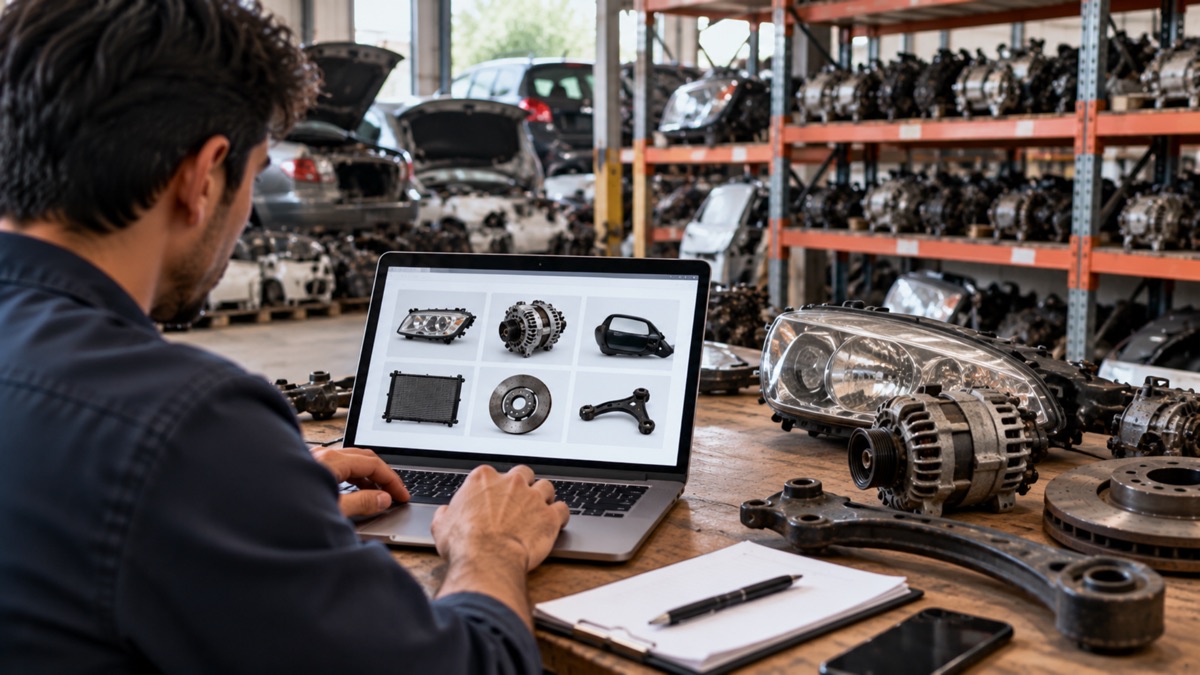
You need a transfer case for a nine-year-old SUV. You call four yards: two promise to check but never call back, one has the wrong drivetrain configuration, and the fourth wants $1,100 without sharing the mileage. Three days pass, nothing is ordered, and the car is still on the lift. An auto parts locator can streamline the search by sending one request to yards you might not have thought to call.
Sourcing used components once depended on knowing yard owners. Now shared inventory databases help match parts to precise vehicle details. Quality Auto Parts can help you provide the information needed for a better match. Contact Quality Auto Parts to start your search.
What an Auto Parts Locator Actually Does
Strip away the marketing and the mechanism is simple. Salvage yards run inventory management software that catalogues every vehicle they dismantle: year, make, model, engine, transmission, mileage, part condition and stock location. A locator queries many of those systems at once and returns matching stock, with pricing and grade attached.
The value isn’t the interface. It’s coverage. A single yard might hold 400 vehicles. A network reaches inventory across thousands of yards nationwide, which changes the odds completely on anything scarce. For a common Camry alternator, coverage barely matters. For a driver’s side headlight on a discontinued trim in a specific paint code, it’s the difference between finding one and giving up.
Why the Old Phone-Around Method Stopped Working
Nobody Can See the Whole Market
A yard can only sell you what’s in its own lot. The counterperson isn’t hiding anything when they say no; they genuinely don’t know that a yard 600 miles away pulled the exact assembly you need last Thursday. Before shared databases, that part sat there until it was crushed. An auto parts locator exists to surface exactly that kind of stranded stock.
The Time Cost Is Larger Than People Admit
Every day the vehicle sits, you’re paying for it somehow, in rental cars, shop storage, or lost work time. Calling yards individually takes hours spread across days, and each call restarts the same conversation about your VIN and configuration. A used auto parts locator sends that description out once. Quotes come back while you’re doing something else.
How a Used Auto Parts Locator Matches Your Vehicle
VIN Decoding
Your 17-digit VIN resolves build plant, trim, engine family, transmission and emissions package. Those fields drive part numbers. Two identical-looking crossovers from the same year can take different radiator assemblies because one left the factory with a towing package. Matching by VIN removes that guesswork before a single yard is contacted.
Interchange Logic
This is where the real gains sit. Interchange data records which parts are physically identical across different models and years. Your 2015 model may show nothing in stock, but if the same door shell was used from 2013 through 2018 across two badge-engineered models, the pool of candidates multiplies. A good used auto parts search runs interchange automatically rather than expecting you to know it already.
What a Good Auto Parts Finder Shows You
Not every result set is equally trustworthy. Compare what you’re shown:
| Field shown | Why it matters | Missing it means |
|---|---|---|
| Stock number | Ties the quote to a physical shelf item | The part may be theoretical |
| Donor mileage | Predicts remaining service life | You’re buying blind on wear |
| Grade (A/B/C) | Summarises condition and age | Cosmetic surprises on arrival |
| Warranty term | Sets your recourse if it fails | Assume none until stated |
| Freight estimate | Heavy items can add hundreds | The quote isn’t the real cost |
A listing with all five is worth more than a cheaper listing with two. That is the practical test for judging any auto parts finder you’re thinking of using.
Where the Technology Still Needs a Human
Software matches numbers. It doesn’t inspect. An auto parts locator can tell you a compatible transmission exists in Ohio with 78,000 miles on it, but it can’t tell you whether the yard drained the fluid properly, whether the case has a hairline crack, or whether the donor car was flooded. Those answers come from asking.
There’s also the diagnosis problem. Locator software assumes you know which part failed. Plenty of alternators get replaced when the actual fault was a corroded ground strap. Before you commit to a part, confirm the diagnosis with a shop, especially on electrical and drivetrain work where returns are restricted once the item is installed.
How to Use an Auto Parts Locator Well
Getting good results is mostly about what you put in. Work through this before you submit:
1. Have the full 17-digit VIN ready, not a partial.
2. Note the transmission type and drivetrain (FWD, RWD, AWD, 4WD).
3. Photograph the failed part from three angles, including connectors.
4. Record the OEM number stamped on the old component if it’s legible.
5. Set a realistic mileage ceiling instead of asking for the lowest available.
6. Give a delivery address type, since residential freight costs more.
7. State your install deadline so suppliers can rule themselves out early.
Submit that once and compare the responses side by side. The goal of any used part finder is fewer, better quotes, not fifty listings you have to sift.
Cost, Freight and Warranty in One View
The reason this approach saves money isn’t just competition between yards. It’s that the total cost becomes visible before you commit. A used alternator at $75 from a yard charging $40 shipping with no warranty is not better than a $110 unit with free shipping and a six-month term. A used auto parts search that shows freight and warranty alongside the price makes that obvious in seconds, which is exactly what a well-built auto parts locator is for.
Indicative ranges help set expectations. Small electrical components often land between $50 and $200. Body panels typically run $120 to $600 depending on size and whether the paint code matches. Drivetrain assemblies climb into four figures, plus freight and a core charge. Actual pricing depends on donor availability, so read those as ballparks rather than quotes.
Frequently Asked Questions
Is an auto parts locator free to use?
For buyers, generally yes. These services are usually funded by the sellers or by a margin built into the part price, so submitting a request typically costs nothing. What you should confirm is whether the price quoted includes freight and any core charge, since those are the two figures that change the real total.
Can I find used auto parts for older or rare vehicles this way?
Often, yes, and this is where the approach earns its keep. Network coverage across thousands of yards makes it far more likely that a 15-year-old body panel or a discontinued module surfaces somewhere. Response times may be longer for rare items, so give yourself a wider deadline.
Do I still need the VIN if I have the part number?
A legible OEM part number is excellent, but send both when you submit an auto parts locator request. The VIN catches trim and package differences a part number alone might not, and it lets the supplier verify the number belongs to your configuration. Between them you eliminate almost every common fitment error.
How fast do quotes usually come back?
For common vehicles, an auto parts locator usually returns responses within a few hours to a business day. Scarce applications can take two or three days as the request circulates through more yards. If nothing lands after that, widen your mileage ceiling or accept a lower grade before deciding the used part finder has nothing.
Conclusion
Sourcing used components has stopped being a matter of who you know and become a matter of how precisely you describe what you need. That change makes it possible to find used auto parts for many vehicles without leaving your desk. An auto parts locator searches wider inventory, filters results by VIN and interchange, and helps you compare price, grade, warranty, and freight. It can’t diagnose your vehicle or inspect a part in person, so involve your mechanic where needed. Used well, it can turn days of unanswered calls into a clear decision.
Chasing a part that isn’t turning up locally? Contact Quality Auto Parts with a complete request to ask about availability, pricing, and options across the collection. Reach out to learn more and get help finding a match for your vehicle.