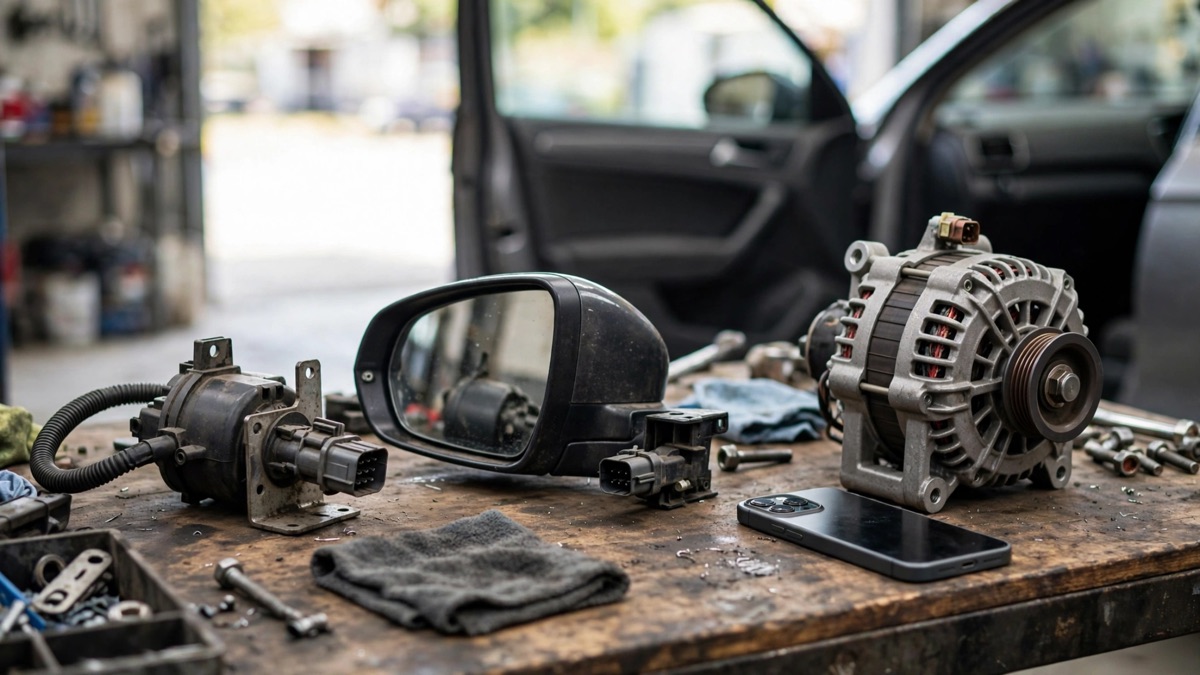
You call a salvage yard about a window regulator and get six questions back before anyone quotes a price. Which side. Which trim. Two-door or four. Does it have the express-down feature. What’s the VIN. Most people don’t have three of those answers ready, and the call ends with “let me check and call you back,” which is where a day disappears. Quality Auto Parts makes the process easier by helping you provide the right vehicle and part details upfront.
Gathering the right details before you ask is the whole trick. It takes about ten minutes with a phone camera, and it changes a two-day back-and-forth into a same-day quote. Here’s exactly what to find a used car part quickly, and why each item matters. With Quality Auto Parts, having these details ready can make your search faster and help you find the right replacement part with less hassle.
What a Supplier Needs to Find a Used Car Part
Every reputable recycler works from the same core set of inputs. Miss any one and your request either stalls or gets answered with a guess.
• Vehicle identity: the full 17-character VIN, plus year, make, model and trim
• Part identity: what it is, which side, which position, and its factory part number if visible
• Condition expectations: acceptable grade, mileage limit, cosmetic tolerance
• Delivery details: ZIP code, residential or commercial address, forklift availability
• Timeline: the date you actually need it, not a reflexive “urgent”
That’s it. Five categories. Everything else is refinement.
Vehicle Identification: Beyond Year, Make and Model
Why the VIN outranks everything else
Two vehicles of the same year and model can take different parts depending on engine, transmission, emissions package, brake option and even assembly plant. The VIN encodes all of that, so a supplier can read your build rather than infer it. If you only do one thing before trying to find a used car part, do this. Photograph it from the dashboard through the windshield, and photograph the door jamb sticker too.
The details on the door sticker
That sticker carries the paint code, the axle code, tyre information and often the production month. Production date matters more than people expect, because manufacturers make running changes mid-year. A car built in October can take a different bracket from one built the following March under the same model year.
Identifying the Part Itself
Numbers on the old component
Alternators, starters, compressors, modules, mirrors and most sensors carry a printed or stamped part number. Find it, photograph it, send it. When you find a used car part using a factory number, the match is close to exact, and it also catches cases where a previous owner installed something that doesn’t correspond to your VIN at all.
Photographs beat descriptions
Send three: the part in place, a close-up of connectors and mounting points, and one showing any casting marks. Connector pin counts, bracket shapes and mounting hole spacing are what actually determine fitment, and none of that survives being described in words. A used auto parts search runs far faster when the person on the other end can see what you’re holding.
How an Auto Parts Locator Uses What You Send
An auto parts locator is essentially a broadcast tool. Your request goes out to a network of yards, and their systems match it against inventory indexed by interchange number. The quality of what comes back depends entirely on the quality of what went in.
Feed it a VIN and a part name with position, and the network returns real matches with grades and prices. Feed it “door for a Corolla” and you get either silence or three quotes for parts that may not fit. A replacement part finder can’t infer what you didn’t say, and neither can the used part finder built into a supplier’s own website.
Automated tools versus a human parts specialist
Automated systems are quick and good at common vehicles. A person is better at edge cases: retrofitted equipment, discontinued platforms, parts that were superseded twice. If an auto part finder returns nothing on the first pass, that’s usually a prompt to send photos to a specialist rather than to give up. The same applies to a replacement part finder built into a marketplace listing page.
Condition, Grade and Mileage Preferences
Say what you’ll accept before quotes come in, otherwise you’ll compare parts that aren’t comparable.
| Detail to specify | Example | Why it matters |
|---|---|---|
| Grade | A only for visible panels | Prevents cosmetic surprises |
| Mileage cap | Under 90,000 for an engine | Sets the price bracket |
| Damage tolerance | Small dings acceptable, no rust | Widens or narrows supply |
| Colour requirement | Code must match, blending planned | Painted panels only |
| Testing required | Bench-tested alternator | Filters untested stock |
For mechanical items, ask what testing was performed rather than assuming. A bench test under load on an alternator, or compression numbers on an engine, tells you something. “Ran when pulled” tells you nothing.
Logistics Details That Change the Quote
Freight is where estimates quietly grow. Doors, hoods, bumpers, engines and transmissions ship on pallets by commercial carrier, and the cost depends on your address type. A residential delivery with a liftgate typically adds $75 to $150 over a commercial address with a dock or forklift.
Give the supplier your ZIP code up front and say whether you can unload a pallet. Indicative freight on a heavy assembly commonly falls between $250 and $500 within the continental US, though distance and fuel surcharges move that. Small parts go by parcel and rarely need this conversation.
A Reusable Template to Find a Used Car Part
Keep this in your notes app and fill the blanks each time.
1. VIN: full 17 characters, plus a photo of the plate
2. Vehicle: year, make, model, trim, engine, transmission
3. Part: name, side, position, factory part number if readable
4. Photos: part in place, connectors, part number label
5. Condition: acceptable grade, mileage limit, testing required
6. Delivery: ZIP, residential or commercial, liftgate needed or not
7. Timeline: the date it’s genuinely needed
8. Flexibility: whether a comparable interchange is acceptable
That block answers nearly every question a supplier asks in order to find a used car part. Send it to two or three at once, and compare grade, price and freight date side by side rather than chasing the cheapest number in isolation.
What Goes Wrong When Information Is Missing
The common failure isn’t a dishonest supplier. It’s an incomplete request answered optimistically. No auto part finder can compensate for a missing trim level, so somebody assumes the base model, ships the base part, and the connector turns out to have two pins instead of four. Return shipping on a heavy component runs $100 to $400, restocking fees often sit around 15 to 25 percent, and the labour already spent is gone.
Missing colour codes cause a second version of this. A panel arrives in the right code, but a decade of sun means it won’t match without blending, and nobody budgeted for that.
Frequently Asked Questions
Can I find a used car part without the VIN?
For wear items, glass, wheels and most suspension components, year, make, model and trim are usually enough. Anything electronic, emissions-related or tied to an option package needs the VIN. If you’re unsure, send it anyway. It costs nothing and prevents the most common category of mismatch.
How does a used part finder decide what fits my car?
It matches your vehicle data against interchange numbers, which record part numbers that substitute for each other across models and years. That’s why a quote might reference an unfamiliar donor vehicle. Ask for the interchange number and confirm it against your VIN before paying.
How long does a used auto parts search usually take?
Complete requests typically return quotes within a few hours to one business day. Sparse requests take longer because someone has to ask you questions first. Rare or discontinued parts can take several days while suppliers check inventory that isn’t fully catalogued online.
Should I send the same request to several suppliers?
Yes. Sending one complete request to two or three suppliers gives you a realistic view of price, grade and availability. Just compare like with like: a Grade A part with faster freight can be better value than a cheaper Grade C part arriving a week later.
Conclusion
To find a used car part without wasting days, gather the information before you ask rather than during the conversation. The VIN, door jamb sticker, clear part number, three photographs, grade and mileage limits, ZIP code, and a realistic date can cover almost every question a supplier may raise. Quality Auto Parts makes it easier to share these details and find a suitable part for your vehicle. Send all the information in one message to more than one source, then confirm the interchange number in writing before you pay. Ten minutes of preparation can save several days and often prevent the hassle of a return shipment.
If you’re tracking down something specific, sharing these details with an experienced parts supplier like Quality Auto Parts can help you get an answer matched to your vehicle faster.
Need help finding the right used car part? Contact Quality Auto Parts today.