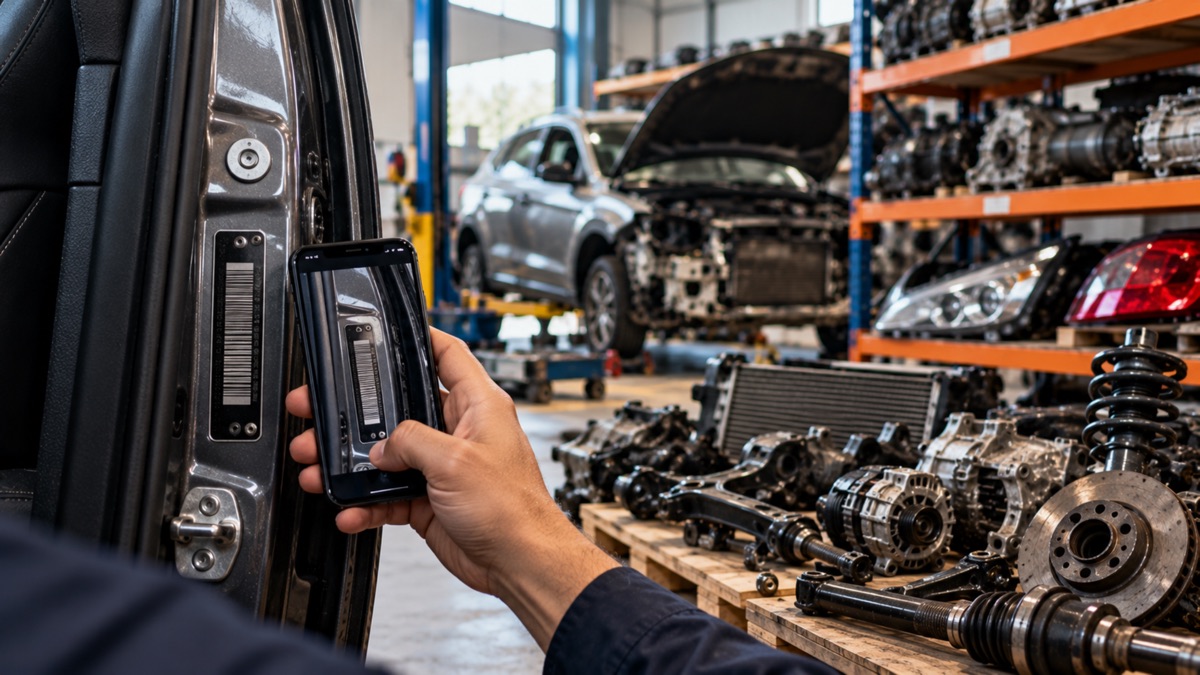
Two sedans of the same year and model can sit side by side and share fewer components than you’d think. Different engines, brake packages, midyear supplier changes, or assembly plants can all affect fit. Searching for used auto parts by VIN helps identify the right component, while searching by model name alone may lead to a return.
Your vehicle identification number is a 17-character build record. It answers questions a parts supplier would otherwise need to ask one at a time, and it takes seconds to copy from the dashboard or door-jamb sticker. Quality Auto Parts can use your VIN to help narrow down compatible parts. Share it with Quality Auto Parts to make your search more precise.
What Those 17 Characters Actually Encode
A VIN isn’t a random serial. It’s structured, standardised and readable by anyone with the right database, which is what makes ordering used auto parts by VIN so much more accurate than describing your car.
| Positions | What they identify |
|---|---|
| 1 to 3 | World manufacturer identifier: maker, country, vehicle type |
| 4 to 8 | Descriptor section: model, body style, engine, restraint system |
| 9 | Check digit that validates the whole number |
| 10 | Model year |
| 11 | Assembly plant |
| 12 to 17 | Sequential serial number for that specific vehicle |
The descriptor section does the heavy lifting
Positions four through eight tell a supplier your engine family, body configuration and often your transmission and trim. For most mechanical parts that’s the decisive information. Two vehicles with identical badges but different engine codes take different alternators, different mounts, different cooling components and sometimes different suspension geometry.
Why the plant code and year matter
Position eleven identifies the assembly plant, and position ten the model year. Manufacturers frequently source the same component from two suppliers at two plants, which produces subtle differences in connectors, brackets and mounting points. Build date, available from the full VIN through a dealer or a recycler’s system, resolves mid-year production changes that no model listing captures.
Why Searching Used Auto Parts by VIN Beats a Model Description
Interchange databases group components by application, and applications are defined by build data rather than marketing names. When you send a VIN, a recycler queries which part number your vehicle actually left the factory with, then finds every donor car in the network carrying that number, including models with completely different badges.
Searching used auto parts by year make model works acceptably for simple items: a wheel, a mirror glass, an air filter housing on a single-engine model. It falls apart on anything electronically controlled, anything tied to trim level, and anything the manufacturer revised mid-cycle. Buyers who find car parts by VIN report far fewer returns for one plain reason: the search never had to guess.
Parts Where VIN Matching Matters Most
Some components tolerate approximation. Others don’t:
• Engines and transmissions: calibration, gear ratios and mounting differ within one model year.
• ECUs and control modules: often coded to the original vehicle and may need programming.
• ABS pumps and steering racks: vary with drive type, brake package and stability control options.
• Headlights and tail lights: halogen, HID, LED and adaptive variants share a body but nothing else.
• Wiring harnesses and connectors: revised constantly during production runs.
• Seats, dash panels and interior trim: colour, material and airbag configuration all change by build.
For wheels, glass, exhaust sections and many bolt-on brackets, searching used auto parts by year make model is often enough. Knowing which category your part falls into saves time, but if you’re unsure, send the VIN anyway. It costs nothing and removes the doubt.
Where a VIN Can’t Help You
A VIN describes the car as it was built, not as it stands today. If a previous owner fitted a different engine, upgraded the audio, retrofitted towing electrics or replaced a module with one from another vehicle, the build record no longer matches reality. Photograph what’s actually on the car and send that alongside the number.
Dealer-installed accessories are a related gap. Roof rails, hitches, remote starters and some infotainment upgrades were added after the vehicle left the line, so they never appear in the build data. Salvage and rebuilt-title vehicles can carry replacement components from donor cars too, which is worth mentioning when you request used OEM auto parts for one. Sourcing used auto parts by VIN still works on a modified car, but only when the seller knows what changed.
How to Find Used OEM Parts by Vehicle Details Without a VIN
Sometimes the number isn’t available: you’re buying for a project car, the plate is damaged, or you’re sourcing ahead of a purchase. You can still find used OEM parts by vehicle details alone. Give the year, make, model, trim, engine size, transmission type and drive layout, then add the part number from the component itself if you can reach it. Casting numbers, supplier codes and date stamps on the old part often identify it more precisely than any vehicle description.
Photographs help enormously here. A clear image of the connector, the mounting face and any stamped numbering lets a parts specialist confirm the variant visually. That’s usually the difference between a confident match and a guess when the VIN isn’t in play.
Buying OEM Car Parts Online Without Costly Mistakes
Marketplace listings for OEM car parts online rarely carry full application data, and the fitment filters on general sites are built around year, make and model. That’s exactly the level of detail that misses trim-specific variants. Before paying, ask the seller to confirm the part number against your VIN and to send a photo of the number on the actual item, not a stock image. Sellers who quote used auto parts by VIN as a matter of routine have already done that check.
Check the return terms too. Thirty days is common, but electrical components are frequently sold as final sale, and freight on a heavy item can wipe out the saving if the part goes back. Buying used OEM auto parts from a supplier who does the VIN check for you costs marginally more and removes most of that risk.
How to Request Used Auto Parts by VIN and Get a Match
1. Copy the full 17-digit VIN from the dashboard, door jamb or registration document.
2. Name the part clearly, and add the part number stamped on the old one if it’s legible.
3. Attach photos of the component, its connector and its mounting points.
4. Mention any modifications, previous repairs or non-original components fitted.
5. State your grade expectations, warranty needs and deadline.
That’s four minutes of work. It converts a vague enquiry into a database query, which is how requests for used auto parts by VIN get answered the same day instead of turning into a week of messages.
Frequently Asked Questions
Where do I find my VIN?
Look at the lower corner of the windshield on the driver’s side, on the sticker inside the driver’s door jamb, and on your registration and insurance documents. All three should match. The door jamb sticker is usually the easiest to photograph, and it also lists tyre pressures and paint codes.
Is it safe to give a supplier my VIN?
Generally yes. A VIN describes the vehicle, not you, and suppliers need it to match parts accurately. It’s the standard identifier used across the industry to find car parts by VIN. Avoid posting it publicly alongside your name, address or licence plate in open marketplace listings.
Will a VIN tell me the exact part number I need?
Not directly, but a supplier’s system will. The VIN resolves your build record, which maps to factory part numbers and then to interchange data. That chain is how searching used auto parts by VIN produces a shortlist of donor vehicles rather than a list of vaguely similar cars.
Can I search for parts if my VIN doesn’t decode?
Yes. Very old vehicles, imports and some grey-market cars predate the standardised 17-character format. Supply year, make, model, engine, trim and any numbers stamped on the original component instead, along with photographs, and a specialist can usually identify the correct variant from those.
Conclusion
Your VIN is a build record, and sharing it turns a guessing game into a lookup. It tells a supplier which engine, trim, plant, and production window your vehicle came from—details that can determine whether a part fits. Send it with clear photos and the old part number, mention any changes made since the vehicle was built, and state your deadline. Ordering used auto parts by VIN can’t guarantee a perfect outcome, but it helps reduce common causes of returns.
Unsure which variant your vehicle needs? Contact Quality Auto Parts with your VIN and a couple of photos to ask about compatibility, current prices, and available parts. Get in touch to explore the collection and learn more about your options.