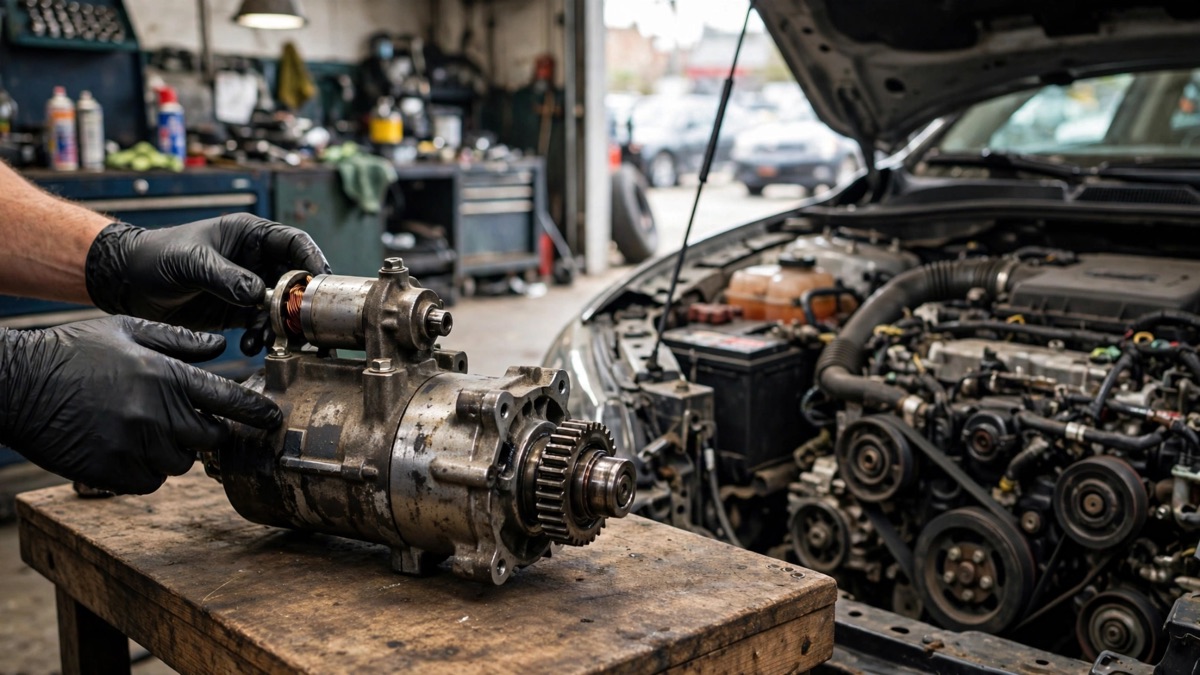
You turn the key on a cold Tuesday morning and get one loud click. Nothing else. The dash lights are bright, the radio plays, the horn works, and yet the engine won’t crank. That single click is one of the most common reasons drivers start pricing out used starters instead of paying dealer money for a new unit. Quality Auto Parts can help drivers find suitable replacement options while avoiding unnecessary dealer costs.
Starters are a strong candidate for a recycled part. They’re simple, they’re mechanical, and a healthy one pulled from a low-mileage donor car will usually outlast the vehicle it goes into. The trick is confirming that the starter is genuinely the failed component, then matching the replacement correctly on the first attempt. Quality Auto Parts makes it easier to explore used OEM options that match the vehicle’s specific requirements.
What a Starter Does, and Why They Fail
The starter is a small, brutally hard-working electric motor. Turn the key and a solenoid pushes a pinion gear out to mesh with the flywheel while closing a contact that dumps a few hundred amps into the motor, spinning the engine fast enough to fire.
Heat, Wear and Short Trips
Two things kill starters faster than anything else. The first is heat soak: units tucked against the exhaust or buried under the intake manifold cook every time you shut the engine off. The second is short-trip driving, which piles up cranking cycles without ever letting the battery recover.
The Components That Give Out First
Failures cluster in predictable places. Worn brushes lose contact with the commutator, so the motor spins weakly. Solenoid contacts burn and pit, producing the classic single click with no crank. The pinion drive wears until it stops engaging cleanly, giving you that grinding whine.
Symptoms That Genuinely Point to the Starter
Be honest about what the car is telling you before you shop. A single sharp click with strong headlights usually means solenoid contacts. Rapid machine-gun clicking almost always means low battery voltage or a bad connection, not the starter. Grinding suggests pinion or ring gear damage, and intermittent no-starts that clear when you tap the housing point to worn brushes.
Rule Out the Cheap Failures First
This is where most people waste money. A surprising share of dead-starter complaints turn out to be a corroded battery terminal, a loose engine-to-chassis ground strap, or a battery that reads 12.4 volts at rest and collapses under load. Load-test the battery and clean both terminals before ordering anything.
Check charging system health while you’re under the hood. A weak alternator quietly murders starters by forcing them to work on a half-charged battery. That’s why shops sell used starters and used alternators to the same customer in the same week. Used alternators and starters fail as a pair more than people expect, so fixing one and ignoring the other buys you a month.
Where Used Starters Come From, and Why Quality Varies
Recycled units come out of salvage vehicles: insurance write-offs, collision cars, and end-of-life vehicles with sound drivetrains. A car rear-ended at 30,000 miles has a starter barely broken in. That’s why used starters from a well-run yard often beat a cheap new import unit on longevity.
What separates a good supplier from a poor one is what happens between the pull and the box. A proper operation records donor mileage, bench-tests the unit under load, cleans it and photographs it. A weaker one wipes it down and ships it. Both sell used electrical auto parts, but only one is selling you a tested unit. Ask whether starters are bench-tested. A vague answer tells you plenty.
How to Match Used Starters to Your Exact Vehicle
Fitment is where used starters go wrong. Two cars wearing the same badge in the same model year can take completely different units depending on engine, transmission and trim.
Start With the VIN
Your VIN encodes engine family, build plant and option details that a year-make-model search misses. Give the full 17 characters to your supplier and let them run it against interchange data. It costs nothing and eliminates the most common cause of returns.
Then Confirm the Physical Details
Even with a VIN match, a few checks are worth doing yourself on older or heavily optioned vehicles:
• OEM part number stamped on the old unit, if still legible
• Mounting bolt count and pattern, typically two or three bolts
• Pinion tooth count, which can differ between manual and automatic applications
• Solenoid terminal layout, since a mismatched plug means splicing
• Nose cone shape and offset, which changes with bellhousing design
Photograph your old starter from three angles before it goes back in the box. That habit settles most fitment disputes in minutes.
Grading, Testing and Warranty Terms
Recyclers grade parts so buyers know what they’re getting. Terminology varies between yards, but grading is still the quickest way to sort used starters by risk.
| Grade | What it usually means | Best suited to |
|---|---|---|
| A | Donor under ~60k miles, tested, minimal wear | A daily driver you plan to keep |
| B | Donor around 60k to 150k miles, tested | Everyday repairs, best value bracket |
| C | High mileage or cosmetic damage, function verified | Older vehicle, budget repair |
| Core | Untested, sold for rebuilding | Rebuilders only |
Warranty matters more than grade. Thirty days is the common floor, 90 days a reasonable middle, and some suppliers offer six or twelve months on tested electrical units. Check whether labour is covered, which it usually isn’t, and confirm the return window separately.
Cost, Core Charges and Shipping
Pricing depends on platform, but as an indicative guide, used starters for a common domestic or Japanese four-cylinder often land between $45 and $110. Diesel trucks, European luxury models and hybrid-specific units run $150 to $400 or more. A new OEM unit frequently sits north of $300 before labour.
Expect a core charge on many orders, typically $20 to $60, refunded once your old unit arrives back. Starters are compact and dense, usually 8 to 15 pounds, so ground shipping stays cheap, which is a real advantage over transmissions or body panels.
Submitting a Part Request That Gets a Match
The quality of the quote you get back mirrors the quality of the information you send. When requesting replacement auto parts, include:
1. Full 17-digit VIN, not just year, make and model
2. Engine size and fuel type
3. Transmission type
4. OEM part number from the old unit if readable
5. Clear photos of the existing part, including the connector
6. Your ZIP code and whether the address is residential or commercial
Suppliers holding used electrical auto parts inventory across several yards can usually find an exact interchange within a day when a request is this specific. Send a vague enquiry about replacement auto parts and you’ll get a vague answer, or the wrong box.
Frequently Asked Questions
How long do used starters usually last?
Tested used starters from a low-mileage donor commonly give several years of normal service, and plenty outlast the vehicle they’re fitted to. Lifespan depends far more on donor mileage, battery health and charging system condition than on the part being second-hand. A weak battery shortens any starter’s life fast.
Can I install a used starter myself?
On many vehicles, yes. It’s usually two or three bolts and two electrical connections. The complications are access and safety: disconnect the negative battery terminal first, and check whether your starter sits under the intake manifold. Read a repair guide for your specific platform before committing to the job.
Is a used starter motor better value than a remanufactured one?
A used starter motor from a low-mileage donor is typically cheaper and is an original factory part. A reman has new wear components but variable rebuild quality. If the recycled option is properly tested and warrantied, it’s often the better buy. If it’s untested, take the reman.
What is a core charge and will I get it back?
A core charge is a refundable deposit that encourages you to send your old part back for recycling. On a starter it’s typically $20 to $60. You get it refunded once the supplier receives the old unit in reasonably complete condition, usually within a set window such as 30 days.
Conclusion
A no-start morning feels like an emergency, but it rarely needs an expensive fix. Confirm the battery, terminals and grounds first, listen to what happens when you turn the key, then match the replacement using your VIN rather than a year-make-model guess. Quality Auto Parts offers used starters from tested, graded inventory, giving you an original factory part at a fraction of dealer pricing, while a decent warranty removes much of the remaining risk. Send photos, ask whether the unit was bench-tested, and read the return window before you pay.
If you’re unsure whether the starter or the charging system is at fault, a short conversation with an experienced parts specialist or a trusted mechanic is the quickest way to avoid buying the wrong thing twice. Quality Auto Parts can help you find the right replacement for your vehicle. Need a reliable replacement starter? Contact Quality Auto Parts today and find the right part for your vehicle.