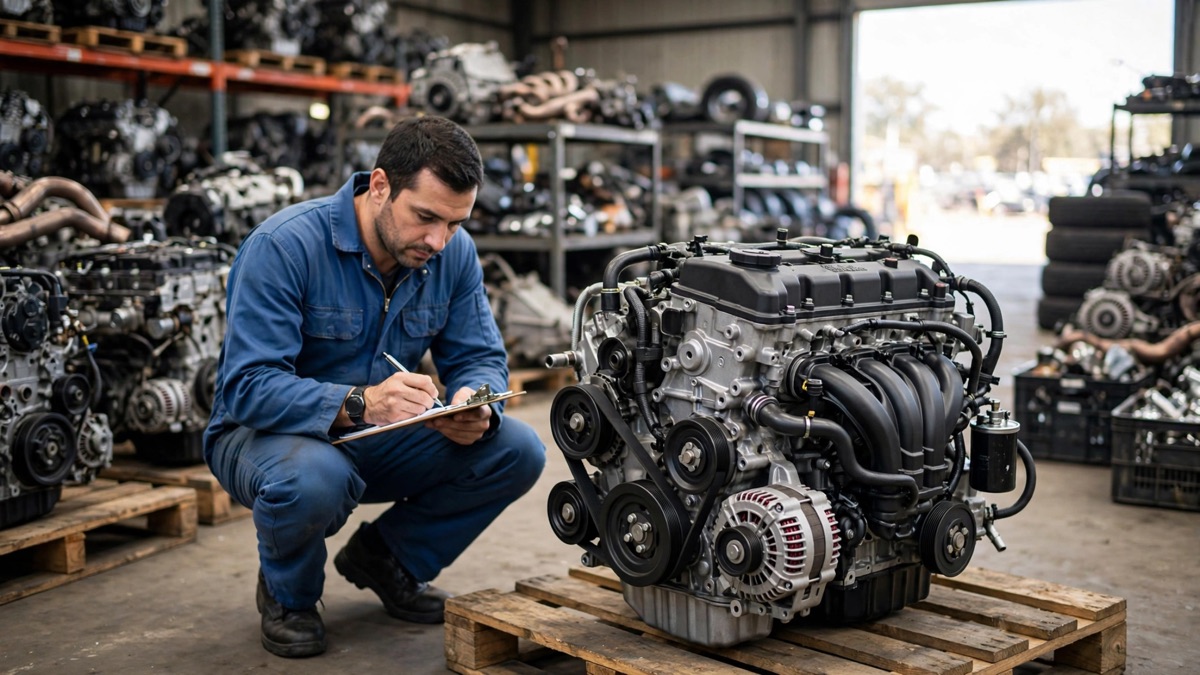
A 2012 Camry with 140,000 miles throws a rod. The body is clean, the transmission still shifts fine, and a new crate motor costs more than the car is worth. That’s the usual road into shopping for used car engines, and it’s a sensible one, provided you know what to ask before money changes hands. Quality Auto Parts can help buyers explore suitable replacement options based on the vehicle’s specifications and needs.
The difference between a good outcome and an expensive one isn’t luck. It’s the questions you ask up front: what was tested, what came attached, what the warranty covers, and whether the part number really matches your build. When comparing used engines, Quality Auto Parts recommends paying close attention to compatibility, condition, testing details, included components, and warranty coverage before making a purchase.
Why Used Car Engines Still Make Financial Sense
The maths is usually simple. A remanufactured unit for a common four-cylinder might run $2,800 to $4,500 before labour, while comparable used car engines from a recycler often land between $700 and $2,000 depending on mileage and demand. On a vehicle worth $6,000, that difference decides whether the repair happens at all.
There’s a second argument that gets less airtime. Used auto engines pulled from low-mileage donor vehicles are factory-assembled units with original tolerances and original castings, not rebuilds where somebody’s machine shop work is an unknown. You inherit whatever wear the donor had, but you also inherit factory assembly. Whether that trade favours you depends almost entirely on how well the donor was documented.
Used Engine Assemblies: Long Block, Complete or Drop-Out
What each term covers
The single biggest source of surprise cost is buying less engine than you assumed.
• Long block: block, crank, pistons, heads, valvetrain. No intake, no accessories, no manifolds.
• Complete engine: long block plus intake, injectors, and usually manifolds. Accessories vary by seller.
• Drop-out or dressed engine: complete plus alternator, A/C compressor, power steering pump, starter, wiring harness attached.
• Engine and transmission assembly: the full drivetrain, often the best value if both units failed or the mileage is high.
Which one you should ask for
If your existing accessories are healthy, a long block keeps the price down and you swap parts over. If your car sat for a year with a seized engine and corroded accessories, a drop-out saves days of labour. Shops quoting used engine assemblies usually mean the complete or dressed version, so confirm in writing rather than assuming.
Mileage, Age and Donor History
Mileage is the first number buyers look at on used car engines, but it means little in isolation. A 90,000-mile engine from a highway commuter is generally in better shape than a 60,000-mile engine from a delivery van that idled all day. Ask what the donor vehicle was, how it was damaged, and whether the damage was a rear-end hit or a front-end collision that may have pushed coolant through the engine.
As a working guideline, most buyers should aim below 100,000 miles on four-cylinder units and below 120,000 on V6 and V8 platforms, though a well-documented higher-mileage engine at the right price can still be the smarter buy. Ask whether the yard has service records or a Carfax-style report for the donor.
Testing Used Car Engines: What “Tested” Should Mean
Compression and leak-down
A compression test tells you the cylinders seal. A leak-down test tells you where they don’t, whether it’s rings, valves or a head gasket. Reputable suppliers of used replacement engines will give you numbers per cylinder, not a pass/fail sticker. Variation of more than about 10 to 15 percent between cylinders is worth questioning.
The phrases that mean nothing
“Ran when pulled” is not a test. Neither is “turns freely.” Two used car engines can carry near-identical listings and be in completely different condition, so ask whether the unit was run on a test stand, whether oil pressure was measured, and whether the timing components were inspected. If the answer is vague, price the engine as though it will need a timing set and gaskets, because it might.
Matching the Engine to Your Vehicle
Two used car engines of the same displacement can be incompatible. Emissions calibration, VVT hardware, injector type, oil pan shape and sensor provisions all shift within a single model year. Send the supplier your full 17-character VIN and the engine code from your existing block or the door jamb sticker, and ask them to confirm the interchange number rather than the displacement.
Watch for federal versus California emissions builds, and for mid-year production changes. Those two catch more buyers of used car engines than anything else. If a supplier offers an engine from a different model, that’s normal, provided the interchange number lines up.
What Used Car Engines Cost and What Else You’ll Pay
The sticker on used car engines is rarely the whole bill. Budget for the surrounding items before you commit.
| Cost item | Indicative range | Notes |
|---|---|---|
| Engine (4-cyl, moderate mileage) | $700 – $1,600 | Varies sharply by platform and demand |
| Engine (V6 / V8) | $1,200 – $2,800 | Truck engines run higher |
| Freight | $250 – $500 | Palletised, needs a forklift or liftgate |
| Core charge | $200 – $500 | Refunded when your old unit ships back |
| Installation labour | 8 – 20 hours | Transverse front-drive layouts take longer |
| New fluids, gaskets, belts | $150 – $400 | Do the timing belt and water pump while it’s out |
Treat those as indicative. Prices move with regional supply, and a common Honda or Ford platform will always be cheaper than a low-volume European unit. If your goal is affordable used engines rather than the lowest possible sticker, weigh the labour cost of a second attempt.
Warranty, Core Charges and Returns
Warranty terms on used engines vary more than buyers expect. Most suppliers of used replacement engines offer somewhere between 30 days and 12 months of parts-only coverage, with extended options sold separately. Read what’s excluded. Parts-only means you pay labour again if the engine fails, which on a 14-hour job is not trivial.
Ask three questions before paying: does the warranty require professional installation with an invoice, does it require an oil change record, and does it cover shipping on a replacement unit? Many claims fail on paperwork rather than mechanics. Keep the invoice, the installer’s records and photos of the engine tag.
Installation Details People Forget
Affordable used engines stop being affordable when the small jobs get skipped. Handle these while the bay is open.
1. Replace the timing belt, water pump, thermostat and all seals while the engine is out.
2. Flush the cooling system properly, especially if the old engine overheated.
3. Transfer or replace the oil pan gasket rather than reusing a crusty one.
4. Update the ECU if the donor had different software, and clear stored adaptations.
5. Send the core back within the stated window, usually 30 days, or forfeit the refund.
Frequently Asked Questions
How long do used car engines usually last?
It depends on donor mileage and how the engine is treated afterwards. An engine with 70,000 documented miles, installed correctly with fresh seals and fluids, commonly runs another 80,000 to 100,000 miles. Neglecting the cooling system or skipping the timing service is what shortens that most often.
Is it cheaper to rebuild or buy used auto engines?
Buying used is usually cheaper up front, often by a wide margin, because a rebuild includes machine shop labour. A rebuild can win on longevity if the machine work is good and documented. For an older vehicle with modest value, most owners come out ahead with a tested used unit.
Do I have to return my old engine?
Usually yes, if a core charge was applied. The old unit needs to be reasonably complete and drained, shipped back on the pallet the replacement arrived on. Miss the return window and the core deposit is kept, which typically costs between $200 and $500.
Will a used engine from a different trim fit my car?
Often, yes. Interchange databases exist precisely because manufacturers share engines across trims and models. What matters is the interchange number, emissions calibration and sensor configuration, not the badge on the donor. Confirm with your VIN before ordering rather than after delivery.
Conclusion
Buying used car engines works well when you treat it as a verification exercise rather than a price hunt. Get the donor history, real compression numbers, and confirm the interchange against your VIN before you pay. Quality Auto Parts can help you check important details and find an engine suited to your vehicle. Also, read the warranty exclusions carefully and budget for freight, the core charge, fresh gaskets, and timing service, as these can affect the overall repair cost. Quality Auto Parts makes it easier to explore suitable replacement options based on your vehicle requirements. Need the right used engine? Send your VIN and mileage details to Quality Auto Parts today and get started.