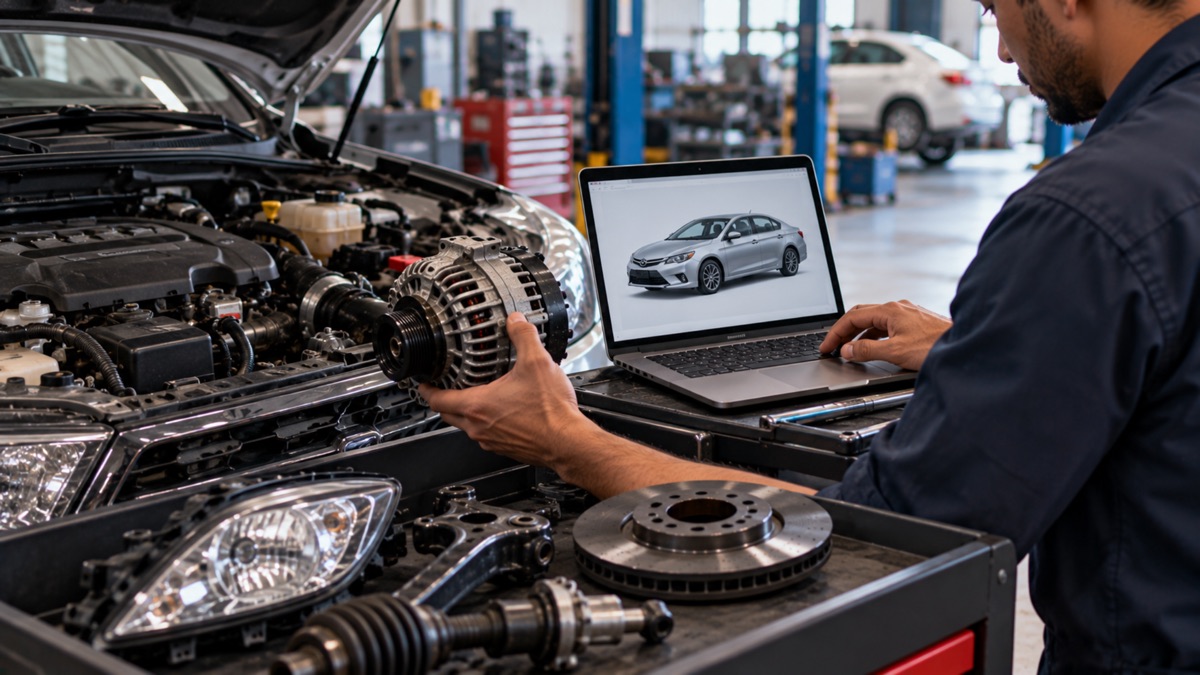
Someone buys a window regulator for a 2015 Malibu, waits five days, and discovers the connector has six pins instead of four. The listing said it fit—but likely fit a different configuration, built at another plant or with a different door module.
Most wrong-part stories start with a part name instead of a vehicle. Shopping for used automotive parts works in the opposite direction: identify the exact vehicle first, then compare price and condition. Searching used automotive parts by VIN helps narrow the options to the right configuration. Quality Auto Parts can help you check fitment details. Share your VIN with Quality Auto Parts to get started.
Why Guessing at Fitment Fails So Often
Manufacturers change components mid-production without changing the model name. A supplier switch in March means cars built in April carry a different bracket. Trim levels compound it: the base car, the towing package, the cold-weather package and the hybrid variant may all use different versions of what a catalog calls one part.
Then there’s the visual trap. Two alternators can look identical and differ by 30 amps. Two ECUs can share a housing and carry different calibrations. Eyeballing a photo is not verification, and photographs are the primary way most people evaluate used car parts online.
Start With the Vehicle, Not the Part
What the VIN Actually Tells a Seller
Those seventeen characters encode the manufacturing plant, model year, engine family, body style and restraint system. A recycler can decode them into the original build configuration, which is far more specific than anything you’d get from a dropdown menu. Searching used auto parts by VIN removes an entire category of error before it happens.
Send the whole VIN, not a fragment. It’s on the driver-side dashboard at the windshield base, the door jamb sticker, and your registration.
When You Don’t Have the VIN
Sometimes the donor vehicle is gone or the VIN plate is unreadable. In that case, gather the next best set: year, make, model, trim, engine size, transmission type, and drive configuration. Then add the number stamped on the old part. That combination gets most searches for used automotive parts close enough to work.
How to Find Car Parts by Make and Model Without Getting Burned
With used automotive parts, make and model alone is a starting filter, not an answer. If that’s all you have, treat every result as a candidate rather than a match, and verify with a second data point before paying. The reliable second points are the OEM part number cast or printed on the original component, the interchange number a seller lists, and a photo comparison of the mounting geometry.
A practical order of operations when you find car parts by make and model:
1. Filter by year, make, model and trim.
2. Pull the OEM number off the failed part and search that number directly.
3. Compare connector type, bolt pattern and orientation against clear seller photos.
4. Ask the seller which other vehicles the part is listed as fitting.
5. Confirm return terms in writing before payment.
Reading a Used Automotive Parts Listing Properly
Grade and Donor Mileage
Most recyclers grade used automotive parts on donor mileage and damage. A-grade generally means low mileage and no impact in that area of the vehicle, B-grade is mid-range, C-grade is functional but higher mileage or scuffed. For engines, transmissions and differentials, donor mileage matters more than grade letters, and it should be stated in writing.
OEM Numbers, Casting Marks and Interchange
The strongest listings show the actual part with its tag visible. Casting marks on heads and blocks, ID tags on transmissions, and printed numbers on modules all let you verify without trusting anyone’s judgement but your own. If a listing for used OEM parts hides the number, ask for a photograph of it. A genuine seller will send one.
Used OEM Parts vs Aftermarket vs Remanufactured
| Option | Typical cost vs new OEM | Best suited to |
|---|---|---|
| Used OEM parts | Roughly 30 to 70 percent less | Body panels, glass, modules, engines, interior trim |
| New aftermarket | Varies widely, often 20 to 50 percent less | Wear items, filters, brakes, common suspension parts |
| Remanufactured | Around 20 to 40 percent less | Alternators, starters, calipers, some transmissions |
| New OEM | Baseline | Safety-critical parts and anything under warranty obligation |
Figures above are indicative and move with model, demand and region. The judgement call is straightforward enough: used OEM makes the most sense where original fit and finish matter and the part doesn’t wear out predictably. Remanufactured suits components with known failure modes and rebuildable cores. Aftermarket earns its place on high-turnover maintenance items.
Where Vehicle-Level Search Matters Most
Used automotive parts don’t all demand the same rigour. Sorting by risk saves time:
• High risk, always match by VIN: engine, transmission, transfer case, ECU and body control modules, ABS units, instrument clusters, airbag components.
• Medium risk, match by trim and engine: alternators, starters, radiators, AC compressors, axles, suspension knuckles.
• Lower risk, make and model usually enough: mirrors, door handles, interior trim, wheels, non-sensor body panels.
Even in the low-risk group, colour codes and camera mounts catch people out. A 2019 mirror without the blind-spot indicator won’t satisfy an owner who had one.
What Used Automotive Parts Actually Cost
Savings on used automotive parts are real but uneven. On a used engine, you might spend somewhere in the 800 to 3,000 dollar range depending on the vehicle and mileage, against several thousand more for new or remanufactured. A used alternator often lands in the 60 to 200 dollar band. A used door shell might run 200 to 700 dollars before paint. All of these are indicative ranges that shift with model, condition and freight distance.
Factor in the parts you can’t see on the price tag. Core charges on rebuildable components typically sit somewhere between 25 and 150 dollars and come back when you return the old unit. Freight on anything palletised can add meaningfully to the total. Compare landed cost, not sticker price, and used auto parts remain the cheaper route in most scenarios by a wide margin.
A Search Workflow That Holds Up
Write down the VIN, the part name with position, and the number off the failed component. Search by number first, by VIN second, by make and model last. Ask two questions of any used auto parts seller before paying: what mileage is on the donor, and what happens if it doesn’t fit. Photograph everything on arrival before you touch a wrench. That’s the whole method, and it works for used automotive parts of any size, from a taillight to a transmission.
Frequently Asked Questions
Are used automotive parts reliable enough for daily driving?
For most components, yes. Original equipment parts pulled from low-mileage donor vehicles frequently outlast budget aftermarket replacements. The sensible exceptions are wear items and safety-critical components with limited service lives, such as brake friction material, belts and airbag units, which are better bought new.
How do I search used auto parts by VIN if I only have the plate number?
You can usually retrieve the VIN from your vehicle registration, insurance documents or title. Failing that, it’s stamped on the driver-side dashboard visible through the windshield and printed on the door jamb sticker. Most sellers can work from that number alone.
What warranty comes with used car parts?
Terms vary by supplier, but 30 to 90 day parts-only coverage is common, with longer options sometimes offered on engines and transmissions. Labour is rarely included. Get the length, the exclusions and the return shipping responsibility confirmed in writing before you pay anything.
Can I return a used part if I ordered the wrong one?
Usually, within a stated window and provided the part hasn’t been installed. Inspection periods are often short, sometimes only a few days. Photograph the item and its tag on arrival, verify the numbers against your old part, and raise any mismatch immediately rather than after the weekend.
Conclusion
Searching well is mostly about sequence. Identify the vehicle, decode it properly, verify the part against a number stamped on the old component, and only then compare prices. Buyers who work this way can avoid returns and get the cost advantage that makes used automotive parts worth considering. Starting with a part name and a hopeful click can cost you twice—in money and time.
If fitment results are confusing or contradictory, contact Quality Auto Parts with your VIN and a photo of the old component. Get in touch to check compatibility, current prices, and more options in the collection, and learn more about finding the right part.