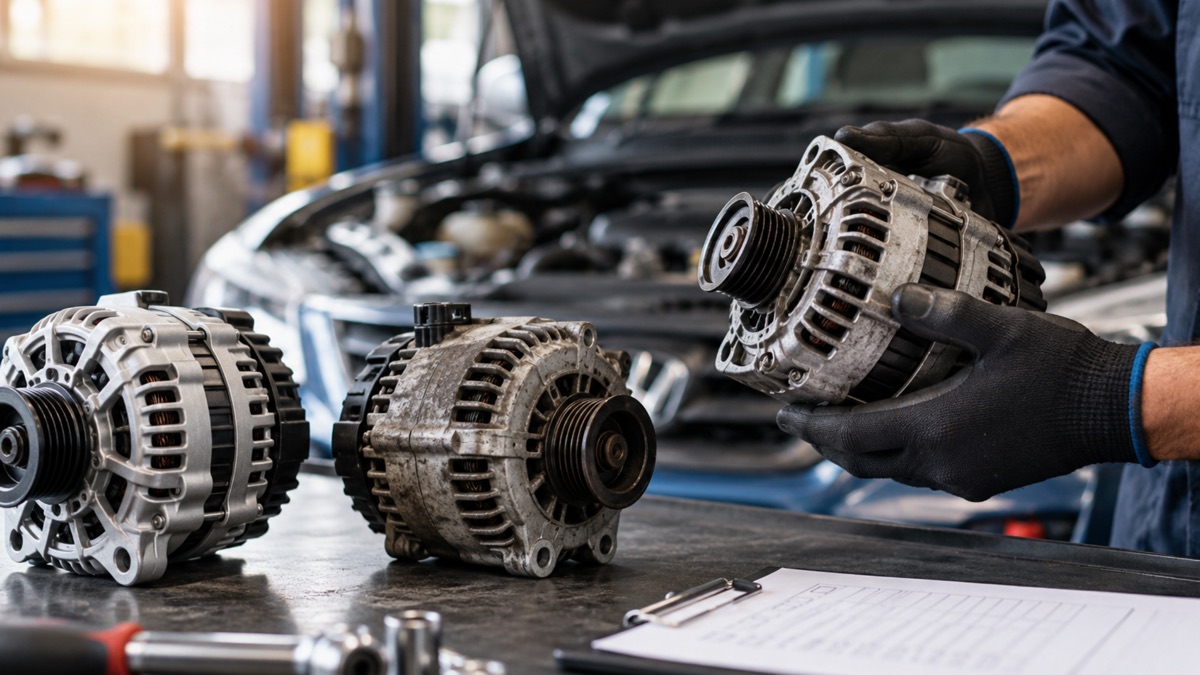
Your battery light flickers on at a stoplight, the headlights dim, and by the time you reach the driveway the radio has cut out. That’s rarely a dead battery. It’s usually the charging system, and once a shop quotes you four hundred dollars for a new unit plus labour, used alternators start looking a lot more sensible.
They often are. A tested unit pulled from a low-mileage donor car can cost a third of dealer price and bolt straight in. Quality Auto Parts can help you check fit and condition before you buy, so you’re less likely to end up with an expensive paperweight. Ask the right questions, compare the part number, and Quality Auto Parts can help you find a better-value replacement.
Charging System Symptoms Worth Trusting
A failing alternator usually warns you first. The dash battery icon glows, fades at idle, brightens when you rev. Headlights pulse in traffic. The blower motor slows every time you brake. Some cars add a whine or a dry grinding sound from the belt area as the bearings wear out.
Before ordering anything, take a voltage reading. A healthy charging system sits around 13.8 to 14.7 volts at idle. Drop below about 13 volts under load and you’re draining the battery on every trip. Climb past 15 and the regulator has failed the other direction, which cooks batteries quickly.
Two things fool people constantly. A corroded terminal or a glazed serpentine belt mimics charging failure almost exactly, and a battery with a shorted cell drags a healthy unit down until it fails too. Rule those out before you shop for used alternators.
Why Used Alternators Are Worth the Money
A new dealer unit for a common sedan runs several hundred dollars before anyone touches a wrench. Used alternators pulled from a running donor vehicle land far below that, and because they’re original equipment they carry the exact connector, pulley and mounting ears your engine bay expects.
| Option | Indicative price | Typical warranty | Best suited to |
|---|---|---|---|
| New OEM from dealer | 650 | 12–24 months | Late-model cars still under a service plan |
| Remanufactured | 300 | 12 months | Daily drivers where downtime is expensive |
| Used OEM / recycled | 180 | 30–90 days, extensions available | Older vehicles, budget repairs, exact-fit needs |
| Budget aftermarket new | 200 | Varies widely | Short-term fixes, rarely a long-term saving |
Treat those figures as indicative. Prices move with the vehicle, the amperage rating and how scarce the casting is. A 220-amp unit off a diesel pickup costs more than a 90-amp one off a compact. The shape of the table holds anyway: recycled originals sit at the bottom of the price range without sitting at the bottom of the quality range.
How to Match Used Alternators to Your Vehicle
Start With the VIN
Your VIN is the shortest route to the correct casting. It encodes engine, trim and build plant, and those decided which unit left the factory on your car. Two identical-looking sedans from the same model year can take different alternators because one shipped with a tow package, a heated windshield or a bigger battery.
Read the Number on the Case
Open the hood and find the sticker or stamped number on the alternator body. Cross-referenced against a supplier’s interchange listing, that figure tells you which other years, trims and sibling brands share the same part. Interchange data is how a yard three states away knows its 2013 crossover unit fits your 2011 sedan.
Respect the Amperage Rating
Never drop below factory output. A car with heated seats, a big stereo and a trailer harness was specified with headroom for a reason, and undersizing shows up as slow cranking on winter mornings. Going a step higher is usually fine, though check the charge wire gauge first.
Testing Standards for Used Automotive Electrical Parts
“Tested” means different things at different yards, so ask what the bench check on used alternators actually involved. A proper test spins the unit under load and confirms output voltage, ripple and regulator behaviour, not just that it makes current for a few seconds. Bearing noise and pulley condition matter too.
Good suppliers of used automotive electrical parts note donor mileage on the tag. Under 80,000 miles is comfortable for a charging unit. They should also confirm pulley type, because a solid pulley and an overrunning decoupler aren’t interchangeable on many modern engines.
Grading, Warranty and Core Charges
Most yards grade inventory before listing it, and the shorthand saves arguments later:
• A grade: donor under roughly 60,000 miles, no visible damage, first choice for a keeper car.
• B grade: higher mileage or light cosmetic wear, mechanically sound, usually the best value.
• C grade: high mileage or a known blemish, priced accordingly, fine for an older second vehicle.
Ask about the return window before you pay. Thirty days is common on replacement auto parts, ninety is better, and paid extensions exist on used alternators and other electrical items. Check whether labour is covered if a part fails after installation, because most warranties cover the component alone. A core charge of $20 to $50 is normal, refunded when your old unit goes back in the box.
Used Starters, Fuel Pumps and Other Electrical Parts
When a Used Starter Is the Better First Buy
Slow cranking gets blamed on the charging system constantly. If the engine turns over lazily but voltage reads correctly, a used starter is a cheaper and likelier fix than a used alternator, and the same VIN and interchange rules apply. Ask about solenoid condition before you commit.
Testing a Used Fuel Pump Before Install
A used fuel pump belongs to the same family of purchases, though the stakes are higher because fitting one means dropping a tank. Insist on a flow and pressure test, confirm the sender and float arm are included, and match the whole assembly rather than the bare motor.
Sending a Part Request That Gets a Fast Answer
The quality of your request decides how quickly you get a usable quote on used alternators. Include:
1. Full VIN, plus year, make, model and engine size.
2. The number stamped or printed on the failed unit.
3. Amperage rating and pulley type if you can read them.
4. Photos of the connector and the mounting bracket.
5. Your ZIP code, so freight can be quoted properly.
Say whether you need it tomorrow or can wait a week. Availability and pricing on replacement auto parts both shift with urgency, and an honest deadline gets you a straighter answer about what’s on the shelf.
Frequently Asked Questions
How long do used alternators usually last?
A unit from a donor vehicle with moderate mileage commonly gives several more years, since brushes and bearings wear slowly. Longevity depends more on your battery and belt condition than on the part’s history. A weak battery forces constant high output and shortens the life of any charging unit.
Can I install a used alternator myself?
On many vehicles, yes. It’s usually a belt tensioner, two or three bolts and a couple of connections. Disconnect the battery first. On transverse engines with tight clearance, or units buried behind the compressor, the job takes longer than the parts saving is worth.
Do used alternators come with a warranty?
Reputable suppliers include standard cover, typically 30 to 90 days, with longer terms available for a modest fee. Keep your invoice and note the installation date. Warranties normally cover the part only, so if labour matters to your budget, ask before purchase rather than after.
What if the part doesn’t fit my car?
That’s what interchange verification and the return window exist for. If the connector or bracket differs, photograph it, contact the supplier promptly and arrange an exchange. Giving your VIN up front prevents almost all of these situations, since fitment errors usually trace back to thin vehicle information.
Conclusion
Buying a used alternator well isn’t complicated, but it rewards patience. Confirm that the charging system is at fault, check your VIN and the number on the old alternator, ask what the bench test measured, and review the warranty before you pay. These steps can help you find a reliable recycled original for less than the cost of a new unit—and avoid doing the job twice.
Unsure which alternator fits your vehicle? Get in touch with Quality Auto Parts for help with compatibility, current prices, and available inventory. Reach out today to explore more options and learn more about choosing the right part.