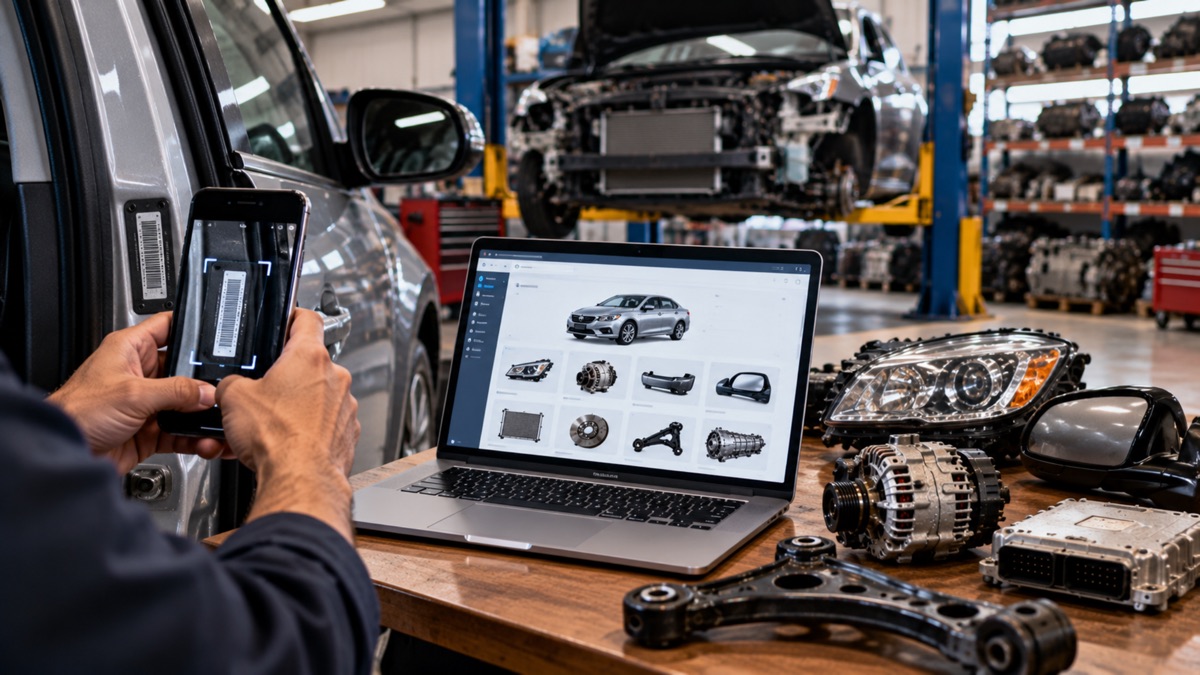
Two identical-looking sedans, same year and same badge on the trunk. One takes a 130-amp alternator; the other needs a 150-amp unit with a different pulley and connector. You order by year and model, the box arrives, and the plug doesn’t fit. The car’s exterior offered no clue, and nobody at the counter could have guessed.
That’s the problem a used auto parts search by VIN and part number can help solve. Each listing connects vehicle details, factory options, and interchange data to identify compatible components. Quality Auto Parts can help you understand what information to provide. Share your VIN and part number with Quality Auto Parts to improve your search.
What a Used Auto Parts Search Is Actually Matching
You think you’re searching for a part. The system is really searching for a vehicle configuration. Every recycled component is catalogued against the donor car it came from, so any used auto parts search is really an exercise in comparing your build to theirs.
Two vehicles can share a nameplate and still differ in engine displacement, drivetrain layout, alternator output, transmission code, brake package and restraint system, all of which determine fit. A few differences are visible from the driveway. Most aren’t.
This is why the good sourcing systems ask for seventeen characters instead of three dropdowns. The dropdowns describe what the car looks like. The VIN describes what it is.
Reading Your VIN: What Those 17 Characters Encode
Where to find it
Look at the driver’s side of the dashboard through the windscreen, the sticker inside the driver’s door jamb, your registration or your insurance card. All four should agree. If they don’t, sort that out before buying anything.
What the blocks mean
• Characters 1 to 3 identify the manufacturer and country of build.
• Characters 4 to 8 are the descriptor section: model line, body style, engine, and restraint system. This block does most of the work in parts matching.
• Character 9 is a check digit that mathematically validates the rest of the number.
• Character 10 encodes the model year.
• Character 11 identifies the assembly plant, which occasionally matters because plants used different suppliers.
• Characters 12 to 17 are the sequential build number for that specific vehicle.
VINs never contain the letters I, O or Q, so they can’t be confused with ones and zeros. If you’ve written one down with an O in it, you’ve copied a zero.
Why Make and Model Alone Often Isn’t Enough
Plenty of people try to find car parts by make and model, and for some components that works perfectly well. Wheels, mirrors, seats and most body panels on high-volume vehicles are stable across a model year.
Then you hit the exceptions. Mid-year running changes are the classic trap: manufacturers revise a harness, bracket or sensor mid-production without changing anything on the badge. Trim-linked options are the other, where a towing package, cold-weather package or upgraded audio system swaps out modules the base car never had.
The honest summary is that make and model gets you into the right neighbourhood. The VIN gets you to the right house. Searching used auto parts by VIN is what closes that gap.
Interchange Numbers: What Makes a Used Auto Parts Search Work
Interchange data is the industry’s map of which components are functionally identical across different vehicles. It’s the reason a good used auto parts search returns more results, not fewer.
A practical example: your model year shows no matching transmissions in stock, but the same unit went into two sibling models and the following model year unchanged. Interchange tables know that. A plain keyword search doesn’t, so you’d have given up while three compatible donors sat on shelves under other names.
When a seller quotes you an interchange number, write it down and check it against your own vehicle data before paying. It’s the most useful verification step available to you, and it takes about two minutes.
When to Find Car Parts by VIN, and When You Don’t Need To
Not every used auto parts search needs the full data trail. Here’s the practical split:
• VIN essential: engines, transmissions, transfer cases, ECUs and body control modules, ABS units, restraint components, emissions hardware, wiring harnesses.
• VIN strongly advised: alternators, starters, AC compressors, radiators, instrument clusters, headlight assemblies on vehicles offered with multiple lighting packages.
• VIN helpful but optional: doors, fenders, bumper covers, tailgates, interior trim and wheels, where you can usually find car parts by make and model.
• VIN rarely needed: floor mats, generic hardware, universal fitment accessories.
The pattern is simple enough. The more electronics or calibration involved, the more it pays to find car parts by VIN. Anything the factory programmed or coded to a specific car should be matched as used auto parts by VIN rather than by description.
How an Auto Parts Locator Uses Your Vehicle Data
An auto parts locator takes your VIN, decodes it into a build specification, expands that through interchange tables, then queries live inventory across a network of yards. Three steps you’d otherwise be doing manually and imperfectly.
The output should tell you more than a price. Expect the donor vehicle’s year and mileage, a condition grade, the interchange number the seller matched on, warranty terms and a freight estimate.
| Data point | What it tells you |
|---|---|
| Donor year and mileage | Expected wear on a mechanical assembly |
| Condition grade (A/B/C) | Cosmetic state and remaining service life |
| Interchange number | Whether the fitment logic is sound |
| Warranty period | Commonly 30 to 90 days on recycled units |
| Freight and delivery type | Terminal pickup costs less than a residential liftgate |
| Core charge | Often $30 to $150, refunded on return of your old unit |
Treat any price figures as indicative. Recycled units typically land well below new OEM pricing, but the gap depends on grade, mileage and how many exist that month.
Verifying the Match Before You Pay
Do these four things at the end of a used auto parts search and mismatches become rare. Compare the seller’s interchange number against your vehicle’s data. Compare the connector in the seller’s photograph against the one on your car, counting the pins if you can see them. Confirm the donor’s engine code and drivetrain rather than just its model name. Finally, confirm the return window and who pays freight if the fitment is wrong.
For electronics, ask one extra question before buying: does this need programming to my VIN after installation, and can my shop do it? A cheap module that needs a dealer visit to code isn’t cheap. Well-matched used OEM parts still beat aftermarket on fit and price for most electronics, but only if you’ve priced the whole job.
Frequently Asked Questions
Can I do a used auto parts search without my VIN?
Yes, and for panels, mirrors, wheels and interior trim it usually works. For anything electronic, calibrated or emissions-related, skipping the VIN meaningfully raises your odds of a mismatch. If you can’t find the plate on the dash, check the door jamb sticker, your registration or your insurance card.
Is it safe to give a seller my full VIN?
Generally yes. A VIN identifies the vehicle’s build specification, not you, and parts suppliers need it to match correctly. It isn’t a password or a title document. Standard caution applies with unfamiliar sellers, but withholding it mainly makes it harder for anyone to send you the right part.
What’s an interchange number and why does it matter?
It’s an industry code identifying a component as functionally identical across different vehicles. Checking the seller’s interchange number against your own vehicle data is the fastest way to confirm fit before money moves, and it frequently reveals compatible stock listed under models you’d never have searched.
Are used OEM parts better than aftermarket?
For fit and electronic compatibility, usually yes, because they’re the same components the factory installed. Aftermarket often wins on price for wear items like pads, filters and belts. For modules, sensors, panels and drivetrain assemblies, a tested recycled OEM unit is the more predictable choice.
Conclusion
A good used auto parts search isn’t about typing better keywords; it’s about giving the system enough vehicle data to match parts properly. Start with the full 17-character VIN. Make and model narrow the options but don’t confirm fitment, so ask which interchange number the seller used. Verify the connector, donor engine code, and return terms before paying. Ten minutes of checking can save the time and cost of shipping the wrong part back.
Unsure which specification your vehicle was built with? Contact Quality Auto Parts for help decoding it, checking availability, and comparing prices. Get in touch to explore more of the collection and learn which options fit your vehicle.