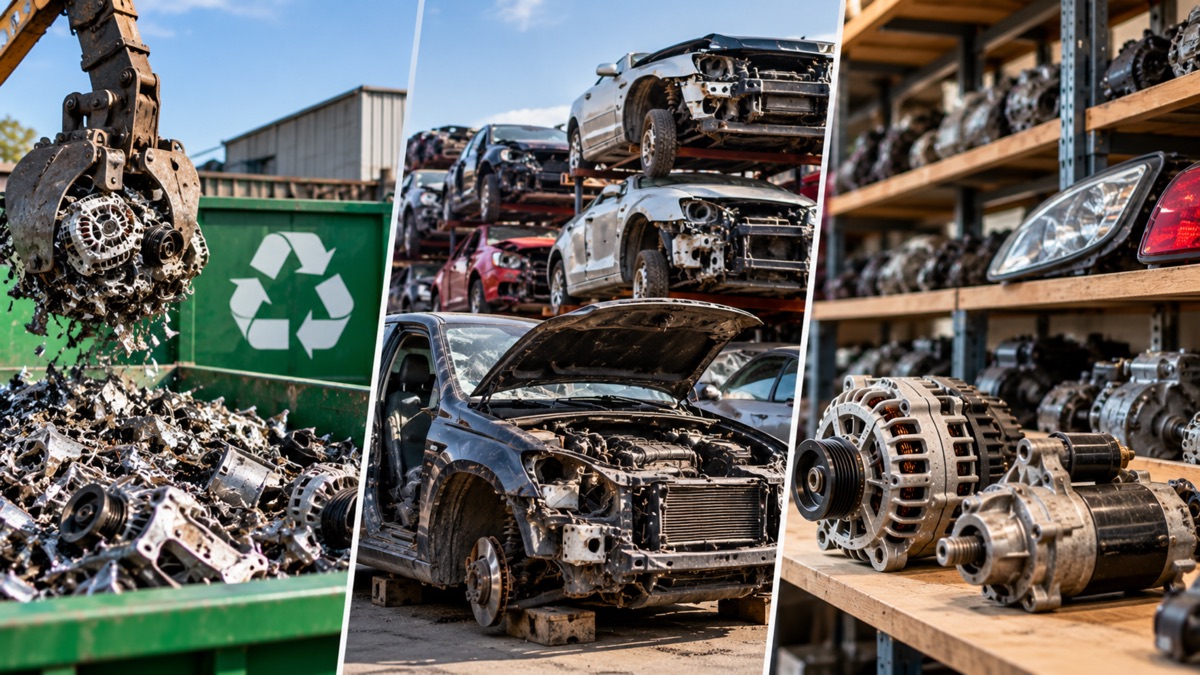
Three suppliers quote you a door for the same car. One calls it recycled, one calls it salvage, and one just says used. The prices differ by ninety dollars, but the listings don’t explain why. Buyers often use the terms interchangeably, yet differences in sourcing and testing can affect what you receive. Understanding recycled auto parts vs salvage and used parts helps you compare listings with more confidence.
Knowing the terminology can help you ask suppliers what they inspect and what’s included. Quality Auto Parts can explain how a part is described and what to check before buying. Contact Quality Auto Parts to compare available options for your vehicle.
Why the Three Terms Blur Together
All three describe components that came off a vehicle rather than out of a factory box. That shared origin is why the industry uses the words loosely and why search results mix them freely. A yard advertising used automotive parts and one advertising recycled inventory may be pulling stock from the same auctions.
The distinction lies in process. How the donor vehicle was acquired, how the component was removed, whether anyone tested it, and what documentation follows it out the door. Those differences don’t show up in the product name, so you have to ask. A yard selling recycled auto parts under a documented system will answer those questions without hesitating.
What Recycled Auto Parts Actually Are
Recycled auto parts come from professional auto recyclers who dismantle vehicles systematically. The donor is inventoried, fluids are drained and captured, components are removed with the right tools, tested where testing applies, then tagged, catalogued and shelved with the donor’s mileage recorded.
The word implies a process, not just an origin. A recycler running a proper operation logs interchange numbers, grades each item, photographs it and lists it in a shared network that other yards and repair shops can search. That’s why recycled auto parts usually cost a little more than something pulled from a field, and why they come with a warranty attached.
You’re buying original factory components, so tolerances, connectors and mounting points match your vehicle exactly. For anything electronic or structural, that matters more than the saving.
What Salvage Auto Parts Mean
Salvage refers to how the vehicle entered the supply chain. A car declared a total loss by an insurer, whether from collision, flood, theft recovery or hail, becomes salvage. Anything harvested from it is technically salvage stock.
Salvage Vehicle Versus Salvage Part
The distinction people miss: a salvage title describes the car, not the condition of every component in it. A vehicle written off after a rear-end collision has a completely undamaged engine, front suspension and dashboard. Buying salvage auto parts from the front of that car is no riskier than buying from any other donor.
Flood and fire histories are the exception. Water reaches wiring looms, modules, connectors and bearings in ways that don’t show on inspection for months. Ask about the loss type before buying electrical items, and be sceptical of unusually cheap salvage auto parts with no history attached.
Where “Used Auto Parts” Fits
Used is the broadest term and carries the least information. It covers everything from a professionally tested transmission to a mirror somebody pulled off a car in a driveway. Buying used auto parts from a private seller or a self-service yard can be genuinely cheap, provided you accept that verification is your job.
The trade-off is real. You save money, you take the risk, and returns are frequently not on offer. For a fifteen-dollar interior trim clip, that’s a sensible bargain. For a fuel pump or a body control module, it usually isn’t.
The Three Side by Side
| Factor | Recycled | Salvage | Generic used |
|---|---|---|---|
| Source | Professional dismantler | Insurance total-loss vehicle | Any second-hand source |
| Testing | Standard on electrical and drivetrain | Varies by yard | Often none |
| Grading | Documented A/B/C with mileage | Usually documented | Rarely |
| Warranty | 30–90 days, extensions available | Commonly offered | Frequently none |
| Price | Moderate | Low to moderate | Lowest |
| Best for | Drivetrain, electronics, panels | Undamaged areas of the donor | Trim, brackets, cosmetic items |
Read that table as a spectrum rather than three separate industries. Plenty of yards sit in more than one column depending on the item, and the same warehouse may sell graded recycled auto parts alongside untested shelf stock at a lower price.
Grading, Testing and Warranty
How Grading Works
Most professional inventory carries a grade based on donor mileage and condition:
• A grade: donor under roughly 60,000 miles with no damage in the relevant area.
• B grade: moderate mileage, sound condition, the sweet spot for value.
• C grade: high mileage or visible wear, cheapest, fine for older vehicles.
What Testing Should Involve
Ask what “tested” meant in practice. For an alternator it should mean a load bench, not a quick spin. For a transmission it might mean a fluid inspection and a pressure check rather than a full road test. For used OEM auto parts like engines, compression and leak-down readings are the meaningful numbers, and a good supplier will share them.
Warranty length tells you how confident the seller is. Thirty days is standard, ninety is a mark of a decent operation, and paid extensions to six or twelve months exist on major assemblies. Almost all cover the part only, not the labour to fit it.
Which Should You Buy: Recycled Auto Parts, Salvage or Used?
Match the source to the stakes:
1. Engine, transmission, differential: buy recycled auto parts with documented mileage, testing and the longest warranty you can get.
2. Electronic modules and sensors: recycled or tested salvage only, and confirm the donor was never a flood vehicle.
3. Body panels and doors: salvage from an undamaged side is excellent value; check the paint code and shipping method.
4. Suspension and brakes: professionally graded stock, since worn components here affect handling.
5. Interior trim, brackets, covers: generic used is fine, and haggling is expected.
For older vehicles the calculation shifts further toward recycled originals. Once a car is past its eighth year, new replacement auto parts often cost a meaningful percentage of what the vehicle is worth, which is difficult to justify unless the component is safety-critical.
The Cost and Environmental Case for Recycled Auto Parts
Recycled auto parts typically land well below new equivalents, with savings on major assemblies frequently reaching half or more of dealer pricing. Exact figures depend on the vehicle and the part’s scarcity, so treat any range as indicative until you have quotes in front of you.
There’s a resource argument too. Reusing an existing component avoids the energy and raw material a new one would consume, and professional dismantlers capture fluids, refrigerants and batteries rather than letting them leak. Buying used automotive parts is one of the few decisions where the cheaper option is also the less wasteful one.
Frequently Asked Questions
Are recycled auto parts safe to use?
Yes, when they come from a professional recycler with grading, testing and a warranty. They’re original factory components, built to the same specification as what left your vehicle. Avoid untested electrical items from flood-damaged donors, and always check the return window before buying anything expensive.
Do salvage parts void my vehicle warranty?
Fitting a used component doesn’t automatically void factory cover, though a manufacturer can decline a claim if that part caused the failure. Keep invoices and installation records. If your car is still under warranty, ask the dealer before fitting non-original items to major systems.
How much cheaper are used parts than new ones?
Savings vary widely by part and vehicle, but recycled auto parts commonly cost a fraction of what new replacement auto parts do, with the biggest gaps on assemblies like engines, transmissions and body panels. Factor freight and any core charge into the comparison, since those can close the gap on heavy items.
Can I return a part that doesn’t fit?
Professional suppliers of used OEM auto parts almost always allow returns within a stated window, typically 30 days. Private sellers usually don’t. Confirm the policy in writing before paying, keep the original packaging, and inspect the item the day it arrives rather than the day you install it.
Conclusion
Recycled, salvage, and used describe parts from different angles: how they were sourced, processed, and documented. Recycled parts often come from dismantlers that grade and test components and may provide a warranty. Salvage parts come from vehicles written off by insurers and can be good value when they’re undamaged. “Used” is a broader term, so ask about inspection and coverage. Compare the risk of failure alongside the price.
Choosing a part for your vehicle? Contact Quality Auto Parts to discuss available options, prices, and warranties. Get in touch for help understanding the differences and finding a suitable match.