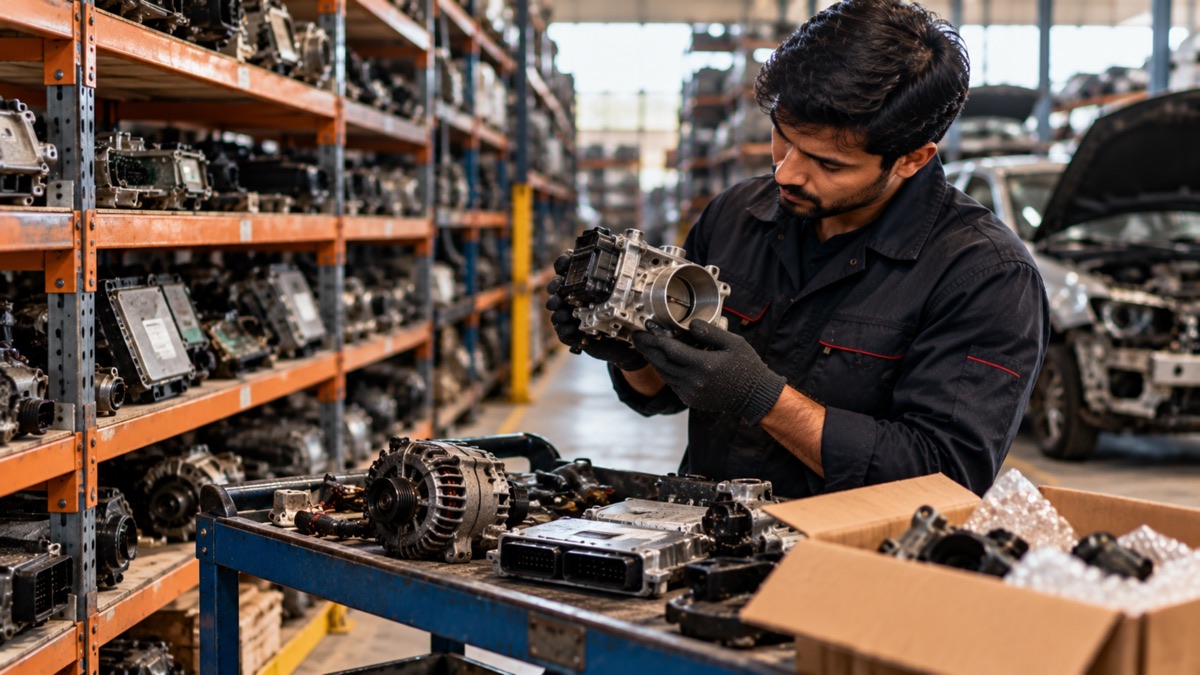
A cracked interior trim panel on a fifteen-year-old wagon shouldn’t be able to stop a repair, but it does. The dealer says the part is no longer available, three online sellers show photos of parts that aren’t quite right, and the vehicle sits in the driveway waiting. Hard to find used OEM parts are rarely gone completely; they may be on a shelf under a number nobody searched for.
People who locate them consistently search by part number, check compatible vehicles, and look beyond general web listings. Quality Auto Parts can help you explore those search options. Contact Quality Auto Parts with your vehicle details to help track down the right part.
Why Hard to Find Used OEM Parts Vanish From the Supply Chain
Manufacturers keep service stock for a defined period after a model ends production, and once that window closes the number is retired. Low-volume trims disappear fastest. So does anything that was only fitted for one or two model years, anything specific to an export market, and anything that was superseded twice before the model was discontinued.
Salvage supply thins out for its own reasons. A part only reaches a recycler when a donor vehicle arrives, and older vehicles get scrapped, exported or stripped for metal. Interior trim, switchgear, unique brackets and body-coloured mouldings are also frequently damaged in the accident that sent the car to the yard, so the survival rate for cosmetic pieces is low. That combination is what turns an ordinary component into one of the discontinued OEM auto parts nobody seems to stock.
Start With the Number, Not the Description
Describing a part in words is the slowest way to search. Numbers are precise, searchable and shared across databases, so every serious search starts there.
Original, superseded and casting numbers
Your part may carry three different identifiers: the original service number, one or more superseding numbers issued later, and a casting or moulding number stamped into the component itself. A number listed as unavailable often supersedes to a later part that is still stocked, and searching the superseded chain in both directions is the single most productive habit when you need to find used OEM parts nobody else can locate.
Interchange across models and brands
Manufacturers share components across platforms far more than buyers assume. The same alternator, door mirror, ABS pump or steering column can appear on three badges and five model names. Interchange databases exist precisely to map this, and a recycler with access to one can tell you in a minute that your part also fits two other vehicles, which multiplies the number of donor cars in the network by a factor of five or ten.
Where Rare Used Auto Parts Actually Live
The listings that show up on a general search are a small slice of what exists. If you want to find rare car parts, widen the net:
• National recycler networks: connected inventory systems let one yard search hundreds of others in real time.
• Dealer dead stock: franchised dealers sometimes hold obsolete inventory for years. A phone call to the parts counter beats an online search.
• Marque specialists and dismantlers: yards that only break one brand know their part numbers cold.
• Owners’ clubs and model-specific forums: long-running enthusiast communities are often the only place rare used auto parts surface.
• Export and grey-market sources: if the model was sold under another name abroad, the part may still be current there.
• Auction and insurance salvage: occasionally the cheapest route is buying a whole donor vehicle and selling the rest.
Each channel takes different effort. A recycler network answers in hours; a forum request may take weeks but sometimes produces the only surviving example. People who reliably find rare car parts run several channels in parallel rather than working through them one at a time.
When the Part Is Genuinely Discontinued
Sometimes nothing turns up because nothing is left. Genuinely discontinued OEM auto parts don’t reappear on their own, but that isn’t the end of the repair.
Repair, refurbish or remanufacture
Plenty of components can be rebuilt rather than replaced. Instrument clusters, ECUs, HVAC control heads, window regulators, calipers and driveshafts all have specialist repair services. Sending your original unit for repair keeps the coding and configuration intact, which for modules is often simpler than sourcing a used one that then needs programming.
Adapt, fabricate or reproduce
Brackets, clips, trim fasteners and simple mechanical pieces can be fabricated or 3D printed. Small specialist makers reproduce common failure items for popular models, and pattern parts from a reputable maker beat waiting indefinitely for something that isn’t coming. For anything structural or safety related, though, stay with an original component and have the work checked by a qualified technician.
Cost and Lead Time: What to Expect
Scarcity sets the price here, not the original value of the component, and hard to find car parts can cost several times what they did new. Decide early how much time and money the hunt deserves.
| Route | Typical lead time | Indicative cost | Best for |
|---|---|---|---|
| Recycler network search | 1 to 5 days | Standard used pricing | Mechanical and common body parts |
| Dealer obsolete stock | 1 to 3 weeks | Often at a premium | New-old-stock trim and electrical |
| Enthusiast community | Weeks to months | Highly variable | Cosmetic and model-specific pieces |
| Repair or remanufacture | 1 to 3 weeks | $150 to $600 typical | Modules, clusters, mechanical assemblies |
| Whole donor vehicle | Days to weeks | Auction price plus transport | Multi-part restorations |
Those figures move constantly with availability and location, so treat them as planning ranges rather than quotes. One rule holds steady: the more precisely you can describe what you need, the cheaper and faster the search gets.
How to Write a Request That Locates Hard to Find Used OEM Parts
Most failed searches fail at the request stage. Give a supplier what they need to find used OEM parts and your odds improve immediately:
1. The full 17-digit VIN, which resolves trim, engine, market and build date.
2. The part number from the component itself, plus any superseded numbers you’ve found.
3. Clear photos, including the mounting side and any connectors.
4. Whether you’ll accept a different colour, a repairable unit, or a part from an equivalent model.
5. Your real deadline and your ceiling price.
That fourth point matters more than people expect. Buyers who say “original colour only, must be perfect” narrow the search dramatically. Buyers who accept a repaintable panel or a serviceable core often find rare used auto parts within days.
Frequently Asked Questions
How long should I wait before giving up on a search?
Give a connected recycler network about a week; that’s long enough for a broadcast request to reach hundreds of yards. Enthusiast communities and specialist dismantlers deserve a month. If nothing surfaces after that, shift to repairing your original unit or looking at a reproduction option instead.
Are aftermarket alternatives acceptable for hard to find car parts?
For non-structural items, often yes. Quality varies widely, so check fit, finish and materials before committing. For safety-critical components, airbag or braking systems, and anything that affects crash structure, stay with original equipment and have installation checked by a qualified technician.
Does buying a whole donor car ever make sense?
For a restoration needing many pieces, yes. If you need five or six hard to find used OEM parts from the same model, an auction vehicle can cost less than sourcing them individually, and you can sell the remainder. Factor in transport, storage space and the time to strip it.
Can a recycler find a part that isn’t listed online?
Frequently. Most yards inventory only a fraction of what they hold, and a lot of stock sits unlisted on shelves. A specific request with a part number and VIN gets checked against physical stock and broadcast to partner yards, which is why asking directly beats scrolling listings.
Conclusion
Finding hard-to-find used OEM parts is a process, not a stroke of luck. Work from part numbers rather than descriptions, check superseded numbers in both directions, and see which other models shared the component. Search several channels, including recycler networks, dealer obsolete stock, specialist dismantlers, and owners’ communities. Decide which compromises you’ll accept on colour, condition, and origin; flexibility can turn a dead-end search into a delivered part. If none is available, repairing or remanufacturing your original may be quicker.
Still searching? Contact Quality Auto Parts with your VIN, part number, and photos to ask about availability, pricing, and other options in the collection. Get in touch to learn more and find out whether the part can be sourced for your vehicle.