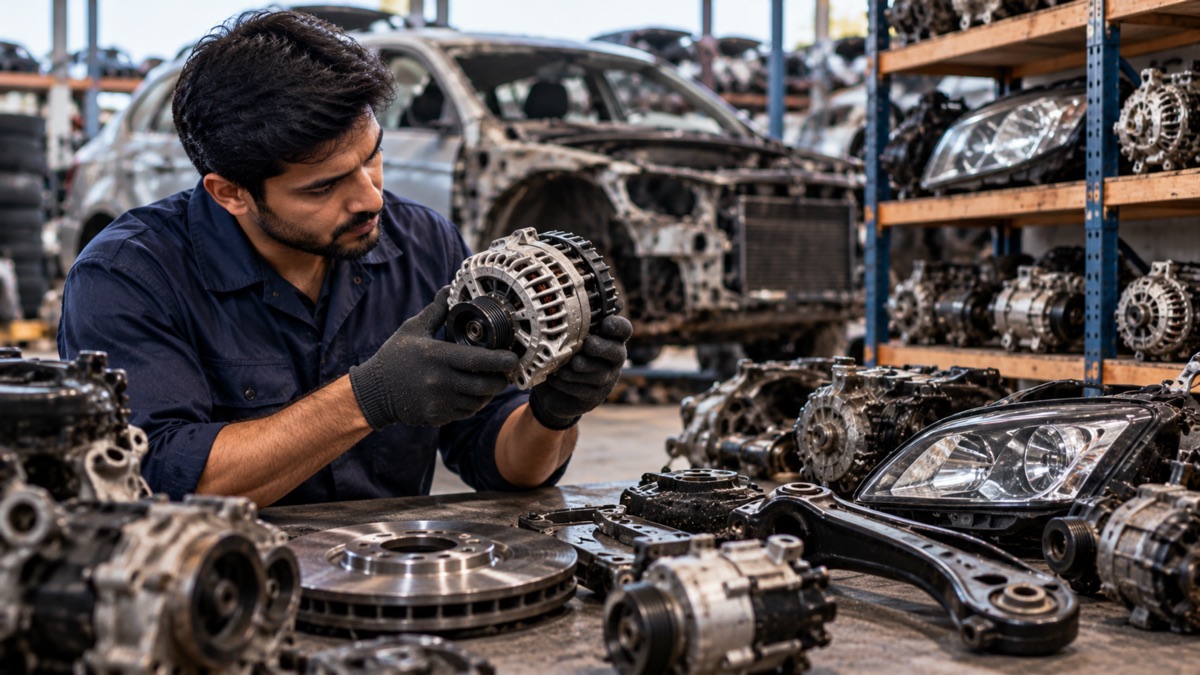
The alternator on your daily driver quits on a Tuesday. The shop quotes $640 for a new unit, and a yard two states away lists the same casting for $95 shipped. The savings are real, and so is the risk. What separates a smart buy from a second repair bill is knowing whether you’re getting properly tested used auto parts or a unit that was simply pulled from a wreck, cleaned, and photographed.
At reputable yards, testing means more than a marketing claim. Some components can be measured and given a test result; others require careful inspection, mileage records, and honest notes about what couldn’t be verified. Quality Auto Parts can help explain what checks apply to a specific component. Ask Quality Auto Parts what was tested before you buy.
What “Tested” Actually Means on a Salvage Yard Floor
The word covers a wide range. At a self-service lot, “tested” often means the donor vehicle drove in under its own power. At a full-service dismantler, it means a technician mounted the unit on a bench, ran it under load and logged a reading against the part number. Two very different levels of certainty.
So ask how the part was verified, not whether it was tested. The phrasing matters. “Was it tested?” invites a yes. “What test did you run, and what were the numbers?” tells you whether tested used auto parts are what’s really on the shelf.
Bench testing versus a visual once-over
Rotating electrical is the easiest category to verify. An alternator goes on a bench that spins it and measures output; a healthy unit generally holds in the 13.8 to 14.4 volt range under load, and a seller who tests will quote the amperage rating. Starters get checked for current draw and solenoid engagement. Modules get powered up, scanned for stored faults and checked for corrosion.
Engines take more work: a compression or leak-down test cylinder by cylinder, the oil pan dropped to look for bearing material, the bores scoped, donor mileage recorded. That’s half an hour per unit, which is why properly inspected used auto parts cost more than the cheapest listing you’ll find.
Parts that can’t be fully tested off the vehicle
Be skeptical of anyone claiming a full functional test on a transmission sitting on a pallet. Without a load and a controller, nobody confirms shift quality outside the car. A careful yard checks fluid colour and smell, inspects the pan magnet, rotates the input shaft and confirms the case is uncracked. Body panels, glass and lamps are inspection items, not test items. Sold honestly, they’re inspected used auto parts, and the listing should say exactly that.
Six Questions That Separate Tested Used Auto Parts From Guesswork
1. What exactly did you test, and what reading did you get?
2. What is the donor vehicle’s mileage, and how was that recorded?
3. Does the interchange number match my VIN, or only my year, make and model?
4. Is there a stock tag on the part I can photograph when it arrives?
5. How long is the warranty, and does it cover labour or the part alone?
6. If it fails on my shop’s bench, who pays return freight?
A dismantler running real used auto parts quality assurance answers all six in about ninety seconds, because the information already sits in their inventory system. Vague replies mean the part never went on a bench.
How Grading Tags Support Used Auto Parts Quality Assurance
Established recyclers grade inventory on a shared convention, and the grade travels with the part on a tag. Useful shorthand, though not a guarantee.
| Grade | What it typically indicates | Best suited to |
|---|---|---|
| A | Low-mileage donor, generally under 60,000 miles, no damage near the part | Engines, transmissions, anything you don’t want to pull twice |
| B | Mid-mileage donor, roughly 60,000 to 150,000 miles | Alternators, starters, most mechanical replacements |
| C | High-mileage donor or visible cosmetic damage | Brackets, panels you’ll repaint, older vehicles |
Body panels carry a second code for damage location and severity, which is why two apparently identical listings differ by $200. Quality used auto parts aren’t always flawless parts. They’re parts described accurately enough for you to decide, and that’s the practical standard for tested used auto parts too.
Testing Standards Vary Sharply by Component
• Alternators and starters: bench tested under load, voltage and draw figures on request. Roughly $60 to $180.
• Engines: compression or leak-down numbers per cylinder, oil pan inspection, timing notes. Indicatively $700 to $3,500.
• Transmissions: fluid and magnet inspection, shaft rotation, case integrity, donor mileage.
• ECUs and modules: powered, scanned, checked for immobiliser pairing and programming needs.
• A/C compressors, radiators, panels and lamps: leak checked where the yard has the equipment; panels get photos and a damage code.
Treat those figures as starting ranges, not quotes.
Why Warranty Terms Say More Than the Listing Photos
A warranty is the cheapest honesty signal you’ll get. A yard that bench-checks its stock knows its own failure rate and prices cover accordingly.
What the term usually includes
Cover on used auto parts with warranty runs from 30 days to a year, with 90 days common on mechanical items and six months to a year on drivetrain. Parts-only replacement is the norm. Labour coverage exists, costs extra, and typically caps at a fixed hourly rate.
Conditions that quietly void it
No installation receipt from a licensed shop. No fluid and filter change on a transmission. A missing stock tag. Photograph that tag the day the crate opens and keep the invoice with it: most rejected claims on used auto parts with warranty cover fail on paperwork, not on the part.
Red Flags When Sorting Quality Used Auto Parts Online
Stock photography is the first. If a listing shows a catalogue image rather than the unit on a shelf, you don’t know what’s shipping. Blurred or missing part numbers come second, since a clear casting number is the fastest fitment check available. Third is a price far below every other listing for the same interchange, which usually signals wrong fitment or an untested pull dressed up as one of several tested used auto parts on the page. Watch how a seller handles being wrong, too. The businesses worth using send a return label the same day.
How to Request Tested Used Auto Parts and Get a Real Match
Send the full 17-digit VIN, not just year and model. Add the part number stamped on the old unit if it’s legible, plus a photo of the connector or mounting pattern. Mention trim, engine size, transmission type, and options that change the part: towing packages, heated components, upgraded audio.
Then state what you need beyond the part itself: a test reading, a minimum warranty length, a delivery window. Buyers who ask for certified used auto parts and define what “certified” must mean get better matches than buyers who send a model name and hope.
Frequently Asked Questions
How do I know if a used alternator was really bench tested?
Ask for the values, not a yes or no. A yard with a bench can quote output voltage under load and rated amperage, and many will photograph the unit on the tester. If nobody produces a number or a tag, treat the part as inspected rather than tested.
Are certified used auto parts worth paying more for?
Usually yes, on anything labour-intensive. An extra $80 for a verified engine is cheap next to pulling the unit twice and losing the vehicle for another week. On simple bolt-on items you can swap in twenty minutes, a shorter warranty and a lower price makes better sense.
Can a salvage yard really test a transmission before shipping?
Not completely. Nobody load-tests a transmission outside the vehicle without specialist equipment. A good yard inspects fluid condition, checks the pan magnet, rotates the shaft and confirms donor mileage. Anyone promising road-test results on a shelf unit is overselling, and that’s worth knowing before you pay.
What should I do if tested used auto parts fail after installation?
Open the claim immediately and keep everything: stock tag, installation invoice, diagnostic printout. Most warranties cover replacement or refund inside the stated window provided a licensed shop did the work. Waiting until the term expires is the single most common reason a claim gets refused.
Conclusion
Verifying a part before you buy is far less work than replacing it twice. Ask what test was run and what it measured. Match the interchange to your VIN, not just the model year. Read the grade tag and warranty conditions, and photograph the stock number when the box arrives. Tested used auto parts can make otherwise uneconomical repairs worthwhile, provided the listing’s verification is clear.
Sourcing a specific component? Contact Quality Auto Parts with your VIN and a clear photo to check compatibility, availability, and pricing. Get in touch to explore more parts and learn what verification is available for your repair.