Your truck needs a transfer case. The dealer quotes a price that makes you laugh out loud, the first two salvage yards put you on hold, and the third promises to check the back lot but never calls back. That’s when people often start scrolling listings at random, hoping something looks close enough.
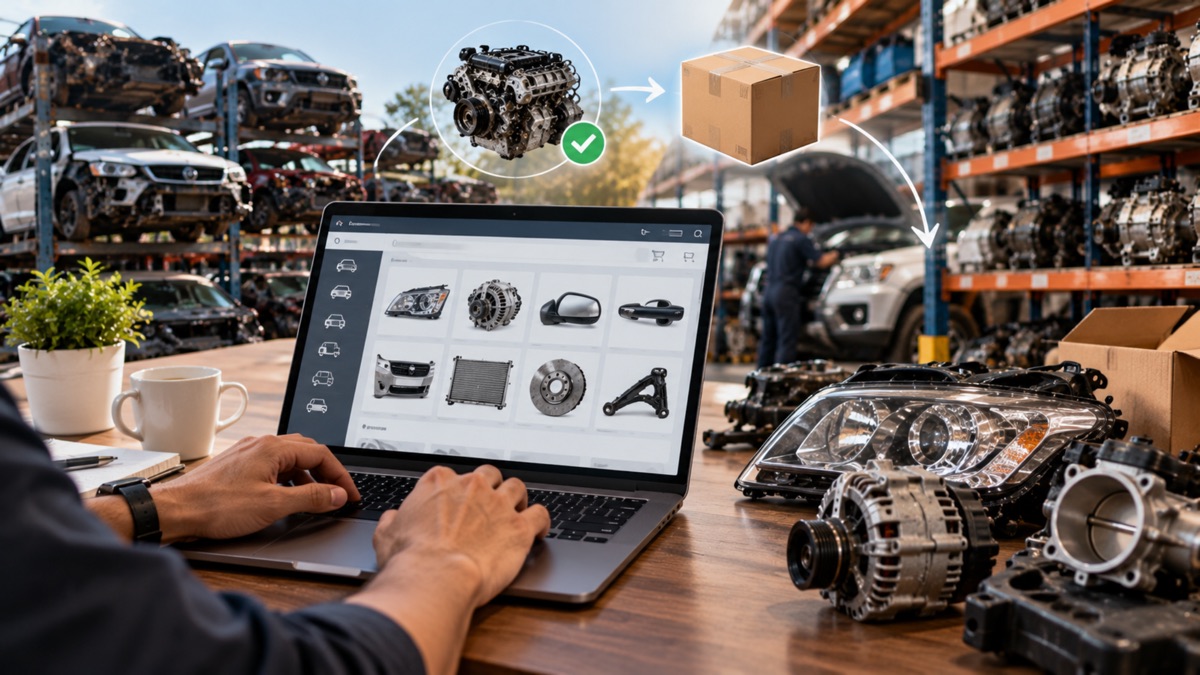
There’s a better route: submit a used auto parts request with your VIN, the assembly you need, and your delivery ZIP code. It can reach multiple recyclers and match your details against their inventory. Quality Auto Parts can help you understand the request process and what information to include. Send your vehicle details to Quality Auto Parts to start looking for a match.
What Happens After You Submit a Used Auto Parts Request
Your submission doesn’t sit in an inbox waiting for a human to notice it. A used auto parts request gets broken into machine-readable fields: year, make, model, engine code, drivetrain, trim level, and the specific component. That normalised record is checked against live inventory feeds from recycling yards nationwide, many updating stock daily as vehicles arrive and get dismantled.
The matching engine doesn’t only hunt for your exact part number. It reads interchange data, the tables saying a 2015 sedan alternator also fits certain 2016 and 2017 builds if the engine and charging output line up. That’s what most self-directed searching misses. You look for your model year, find nothing, and decide the part is extinct, while three compatible donors sit in yards two states over.
Quotes typically start arriving within a few hours on a business day, each carrying a grade, a mileage figure, the price and a freight estimate.
Why a Used Auto Parts Request Beats Calling Yards One at a Time
The phone method isn’t wrong, it’s just slow and narrow. A single yard can only sell you what’s on its own lot, and no yard holds every model. A used auto parts request reaches all of them in one go.
The time cost nobody counts
Ten calls at six minutes each is an hour of your day, and that assumes everyone picks up. Meanwhile your car sits on jack stands and the bay you were promised goes to someone else. For a shop sourcing four parts a week, the labour cost of hunting quietly exceeds the savings.
Guesswork over the counter
When you describe a part verbally, both sides are guessing. You say “the little sensor near the throttle body,” the counter person pictures something else, and the box that arrives has a different connector. A written auto parts request carrying photos and part numbers cuts that failure mode hard.
The Details That Make a Used Auto Parts Request Work
The quality of your answers depends almost entirely on the quality of your submission. Give the system this much and matching gets sharp:
1. The full 17-character VIN. This one field resolves engine, transmission, trim and factory options without guessing.
2. The part name in plain language, plus the OEM number stamped on the old unit if you can read it.
3. Photos of the part still on the car, including the connector and mounting points.
4. Your zip code, because freight on a heavy assembly changes the real total substantially.
5. Your tolerance for mileage and cosmetic condition, so yards send relevant offers instead of everything they own.
If you’re about to request a car part and can’t find the VIN plate on the dash, check the driver’s door jamb sticker, the insurance card, or the registration.
How Online Matching Handles Hard to Find Car Parts
Discontinued trim pieces, first-year modules and colour-matched body panels are where a broadcast system earns its keep. Hard to find car parts are rarely truly unavailable. They’re scattered, and no single seller can see where. One used auto parts request covers the whole scatter.
A networked used auto parts search widens the net in three directions at once: geographically, across model years through interchange, and across trim variants that shared a component. That last one surprises people, because manufacturers reuse brackets, sensors and mirrors across sibling models and even brands.
Colour is the usual complication with body work. A door shell in the wrong colour costs less and paints fine; a matching-code door saves a paint booth but narrows the pool.
Grades, Testing and What You’re Actually Buying
Recycled parts are graded, and knowing the shorthand stops you overpaying or underspecifying.
| Grade | Typical condition | Best suited to | Price vs. new OEM |
|---|---|---|---|
| A | Low mileage, minimal wear, little to no damage | Engines, transmissions, daily drivers | Roughly 40–60% less |
| B | Average mileage for age, minor cosmetic flaws | Alternators, starters, brackets, interior trim | Roughly 50–70% less |
| C | High mileage or visible damage | Non-critical panels, older vehicles, budget repairs | Often 70%+ less |
Mechanical assemblies should be tested before shipping. Alternators and starters get bench-tested for output and draw, engines are compression- or leak-down-checked, and electronic modules often need programming to your VIN after fitting, a labour cost worth asking about upfront.
Core Charges, Freight and Warranty Windows
Three line items decide whether a bargain stays a bargain.
Core charges apply to rebuildable units such as alternators, starters, calipers and some transmissions. You pay a deposit, typically $30 to $150 depending on the component, refunded when your old unit ships home. Keep the packaging.
Freight is where heavy parts surprise people. A sensor ships in a small box for a few dollars, but an engine or transmission moves by pallet on a freight carrier, and depending on distance budget in the low hundreds. Ask whether the quote covers residential or terminal delivery, because a liftgate drop at your driveway costs more.
Warranty windows on recycled parts commonly run 30 to 90 days, with longer coverage sometimes offered on drivetrain assemblies for a fee. Read what it covers: most replace the part, far fewer pay the labour to install it twice.
Reading a Used Part Finder Listing Without Getting Burned
A good used part finder result gives you enough to verify the match yourself. Any decent used auto parts search should show you the donor vehicle, not just a catalogue picture. Watch for these warning signs:
• No stock photo of the actual unit, only a generic catalogue image
• No donor vehicle mileage listed on a mechanical assembly
• Vague fitment language like “fits most models” with no interchange number
• No stated return window, or a restocking fee above 25%
• Pressure to pay by a method with no buyer protection
Cross-check the interchange number the seller quotes against your vehicle before paying. Two minutes of verification prevents a two-week return.
Frequently Asked Questions
How long does a used auto parts request usually take?
Most systems return their first quotes within two to four business hours, with the bulk arriving inside a day. Rare or discontinued components can take two to three days as regional yards check physical stock. If nothing comes back within 72 hours, widen your mileage and cosmetic tolerance and resubmit.
Can I request a car part without knowing the VIN?
Yes, but expect less precision. Year, make, model, engine size and trim will get you close on common items like mirrors or panels. For transmissions, ECUs and anything emissions-related, the VIN is close to essential because factory options split the fitment in ways the model name never reveals.
Are recycled OEM parts as good as new aftermarket ones?
Often better for fit, since they’re the same components your vehicle left the factory with. Aftermarket wins on price for wear items like brake pads and filters. For sensors, modules, body panels and drivetrain assemblies, a tested recycled OEM unit is usually the more predictable choice.
What happens if the part doesn’t fit when it arrives?
Report it immediately, before installation, and photograph the discrepancy. Reputable sellers cover return shipping when the fitment error is theirs. If you installed it first, most warranties are void, so always trial-fit connectors and mounting points before touching a wrench in anger.
Conclusion
Finding a difficult component isn’t a hunting problem anymore; it’s a matching problem. The vehicles that can supply the part you need may be sitting in yards you’ll never visit, and a well-prepared used auto parts request can reach them. Spend a few extra minutes gathering your VIN, photos, and part number. Then compare responses by grade, mileage, freight, and warranty—not just the headline price.
Still looking for a hard-to-find part? Contact Quality Auto Parts to discuss your request, check current availability and pricing, and explore more of the collection. Get in touch to learn more about sourcing the right part for your vehicle.
.