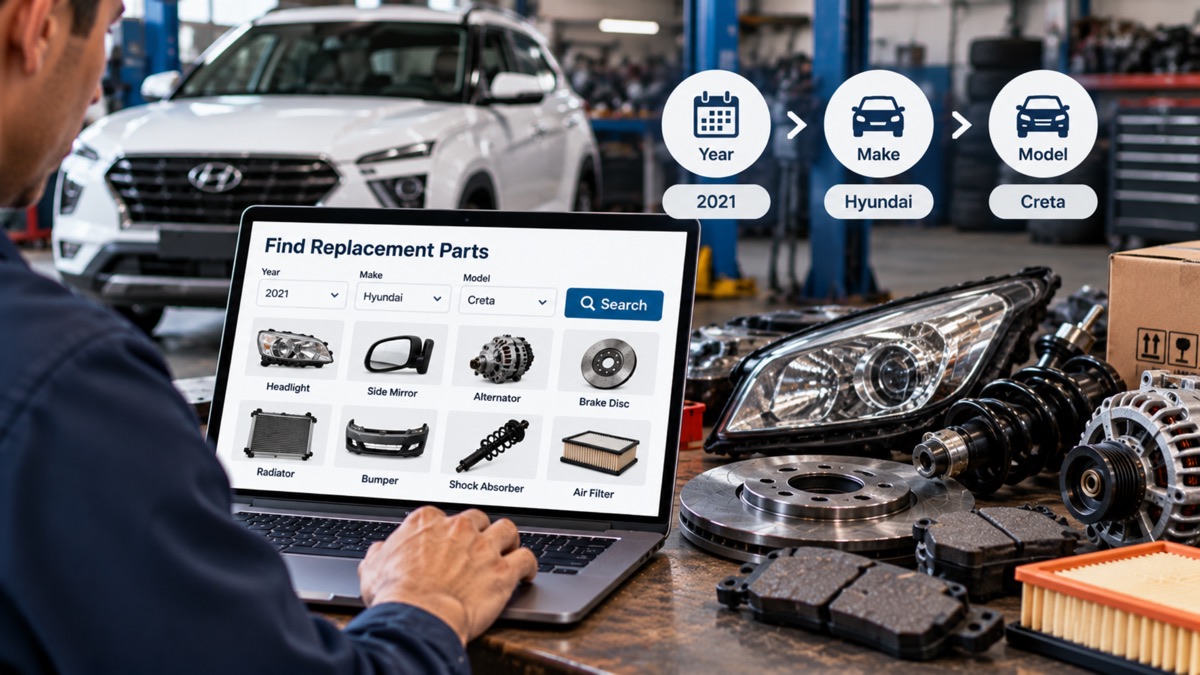
You enter your year, make, and model into a search box, three results appear, and none confirms whether the parts will fit your car. You can find replacement parts by vehicle year, make, and model, but those details only narrow the search.
Year, make, and model can quickly reduce millions of catalog listings to a few options. But manufacturers may change specifications midyear or use different components across trims and plants. Quality Auto Parts can help you check the details before you buy. Share your vehicle information with Quality Auto Parts to find a compatible match.
Yes, You Can Find Replacement Parts by Vehicle Basics
Every parts catalogue in the country is built around the same three fields, because that’s how buyers think. Nobody walks in quoting a casting number. So the industry indexes used auto parts by year make model first, then filters by engine, drivetrain and trim as you narrow the search.
For a large share of items, that’s enough. Body panels on single-trim vehicles, most suspension components, radiators, mirrors and common wear parts are usually consistent across a model run. You can find replacement parts by vehicle description alone and be right the great majority of the time.
Where Year, Make and Model Stops Being Enough
Three fields describe a car the way a shirt size describes a person. Useful, but not precise. Once you move past bolt-on basics, the habit of listing used auto parts by year make model starts hiding differences that matter, and there are three common places it breaks down.
Mid-Cycle Changes
Manufacturers revise parts without renaming the car. A supplier switch in March means a February-built vehicle and a June-built one carry different connectors under the same badge. Nothing in the year, make or model tells you which side of that change you’re on.
Trim and Option Packages
A base sedan and a loaded one from the same line can differ in brake calipers, wheel bearings, wiring harnesses, headlight assemblies and half the switchgear. Towing packages, cold-weather packages and upgraded audio all bring their own hardware. When people try to find car parts by make and model and end up with the wrong item, options are usually the reason.
Assembly Plant Variation
Some models are built in two or three plants, occasionally on different continents, with regionally sourced components. Same badge, different supplier, different part number.
Why the VIN Settles What the Model Name Cannot
Your VIN is a 17-character build record. It identifies the manufacturer, the plant, the model year, the engine family and the sequence number of your specific car coming down the line. Give a supplier that and they can look up how your vehicle was actually configured rather than how the brochure described it.
This is why experienced sellers of used automotive parts ask for it every time. It isn’t bureaucracy. It’s the difference between a part that drops in and a part that sits on your bench while you argue about a return. You’ll find it on the driver’s door jamb, at the base of the windscreen and on your registration and insurance documents.
Interchange Numbers: the Layer Buyers Rarely See
Behind the scenes, recyclers don’t think in model names at all. They work from interchange codes that group parts sharing identical specifications, regardless of which vehicle they came out of. One code might cover four model years, two body styles and a sibling brand sold under a different badge.
That’s genuinely useful to you. If you can only find replacement parts by vehicle name, your pool is limited to cars exactly like yours. Once interchange enters the picture, the pool widens dramatically, which usually means better prices and shorter waits on scarce items.
You don’t need to learn the codes. You just need to know they exist, so that when a supplier offers you a component pulled from a model you’ve never heard of, you understand why it fits. Trying to find car parts by make and model alone throws away most of that inventory for no good reason.
Parts Where Fitment Errors Happen Most
| Part | Risk level with year/make/model only | What to confirm |
|---|---|---|
| Engine assembly | High | Engine code, emissions spec, accessory layout |
| Transmission | High | Calibration code, drivetrain, tag number |
| ECU / body module | Very high | Software version, whether it’s VIN-locked |
| Alternator / starter | Medium | Amperage, pulley type, connector |
| Headlight assembly | Medium | Halogen, HID or LED, and levelling hardware |
| Doors and fenders | Low to medium | Body style, paint code, side designation |
| Suspension arms | Low | Drivetrain and any sport package |
The pattern is simple enough. Anything electronic, calibrated or emissions-related needs more than three fields. Anything mechanical and structural is usually forgiving, and for those you can find replacement parts by vehicle description alone and order with reasonable confidence.
Used OEM Parts, Aftermarket and Reconditioned
Once you’ve identified the right part, you still have to choose a source. The realistic options:
• Used OEM parts: original factory components from donor vehicles. Exact fit, original tolerances, lowest cost for the quality. Condition varies, so grading and testing matter.
• New aftermarket: widely available and cheap, though fit and finish range from excellent to frustrating, particularly on body panels and electrical items.
• Remanufactured: rebuilt to a standard with new wear components. Costs more than recycled, less than new OEM, and usually carries a longer warranty.
• New OEM: the safest and the most expensive, and frequently on backorder for older platforms.
For a vehicle past its seventh or eighth year, recycled originals tend to make the most financial sense. Spending six hundred dollars on a new module for a car worth five thousand rarely adds up, and used automotive parts of the same specification often deliver identical performance. The exception is anything safety-critical with a hidden service history, where new replacement auto parts are worth the premium.
How to Find Replacement Parts by Vehicle Details Fast
The people quoting replacement auto parts all day can help you far more quickly if you hand over the right details. Send:
1. The full 17-digit VIN.
2. Year, make, model, trim and engine size, as a cross-check.
3. Clear photos of the failed part, including labels, connectors and mounting points.
4. Any number printed, stamped or etched on the old component.
5. Your ZIP code and whether the delivery point is residential or commercial.
Add one line about urgency and budget. Saying you’d accept a higher-mileage part to save two hundred dollars, or that the car must be back on the road by Friday, changes which quotes come back. Suppliers can’t guess at priorities they haven’t been told.
Frequently Asked Questions
Can I find replacement parts by vehicle registration number?
Often, yes. Many suppliers can decode a plate or registration document to reach the VIN and build data. Accuracy varies by state and by vehicle age, so treat it as a shortcut rather than proof. If the part is electronic or expensive, confirm with the VIN itself.
Do I need the VIN for simple parts like mirrors?
Not always. Mirrors, door handles and interior trim are usually consistent within a model run, so year, make, model and trim will do. Give the VIN anyway if the vehicle has power folding, heating, blind-spot sensors or memory positions, since those options change the part significantly.
Are used OEM parts as reliable as new ones?
For most mechanical components, yes. A factory part from a low-mileage donor was built to the same tolerances as the one on your car and has plenty of life left. Ask about donor mileage, grading and the testing performed, and check the warranty window before you buy.
What if I can’t find replacement parts by vehicle search anywhere?
Ask a supplier to run interchange on your part instead of searching by car. Components are frequently listed under a different model that shares the same code. If nothing surfaces, leave the request open with a recycler network so it triggers when matching inventory arrives.
Conclusion
You can find replacement parts by vehicle year, make, and model, and for straightforward items, those details may be all you need. For electronic, calibrated, or option-dependent parts, two cars with the same badge can have different components. Sharing your VIN and asking a supplier to check interchange numbers can reduce the risk of ordering the wrong part and help you explore more options. A few minutes of preparation can save time and money.
Still unsure whether a part matches your vehicle? Contact Quality Auto Parts with your VIN and a few photos. Ask about available inventory, prices, and compatibility—or get in touch to learn more about your options.